

Blockchain for Music Session Security: A Practical Workflow
Last Edited: Aug 20, 2026
For session security, use a blockchain-backed workflow that stores lightweight proofs, meaning hashes, fingerprints, and timestamps, on-chain while keeping your actual audio off-chain in decentralized storage. Pair that with audio fingerprinting, watermarking, and smart contracts, and you get provenance you can prove and rights handling that runs itself.
A usable pipeline needs five moving parts working together:
- Standardized metadata (track title, contributors, wallet addresses, timestamps)
- DAW export hooks that trigger hashing automatically
- Decentralized storage for the actual audio files
- Access control tied to participant identity
- A chain-of-custody log that survives disputes
Pro Tip: *Stamp every session file with a content hash and register it on-chain before you send it to anyone else. That single habit closes the biggest gap in most home-studio security setups: the window between “file exists” and “file is provable.” *
Key Takeaways
Securing a collaborative music session requires on-chain proofs, off-chain decentralized storage, layered fingerprinting, and disciplined metadata, not blockchain alone.
| Point | Details |
|---|---|
| Hash before you share | Register a content hash and timestamp for every session file before sending it to collaborators. |
| Split storage by function | Keep hashes and ownership records on-chain; store actual audio in IPFS, Filecoin, or Arweave. |
| Layer your defenses | Combine watermarking, fingerprinting, and on-chain hashing so that removing any single layer does not break provenance. |
| Metadata quality decides outcomes | Standardize contributor names, wallet addresses, and timestamps to avoid locking errors into an immutable record. |
| Pilot with the right DAW | SoundBridge’s export and remote-sync hooks provide teams with a practical starting point for adding hashing and verification steps. |
What Blockchain Actually Gives Session Security, and What It Doesn’t
Blockchain provides four concrete guarantees for a music session: immutability, decentralized validation, a transparent audit trail, and programmable rules via smart contracts. Once a hash is written to a ledger, nobody, not a collaborator, not a label, not you, can quietly rewrite the history of who touched a file and when.

What it doesn’t do is just as important. A blockchain is a terrible place to store a 24-bit, 96kHz stem. It also can’t fix bad data entry: if you register the wrong contributor name or an incorrect timestamp, that error becomes permanent right alongside the truth. This is the “garbage-in, garbage-out” problem that keeps showing up in industry research, and it’s a bigger threat to session security than any hacker.
The scale of the underlying problem is worth sitting with. Research on blockchain adoption in the music industry has found that 20 to 50 percent of royalty payments fail to reach their rightful owners under legacy tracking systems, largely because ownership and contribution records are lost, duplicated, or disputed long after the session ends.
Here’s what that looks like in practice: a producer timestamps a vocal take the moment it’s recorded. Three months later, a dispute breaks out over who sang first, the featured artist or the guest verse. Instead of relying on memory or email threads, the producer pulls the on-chain record and settles it in minutes.
Building Blocks: What Goes Into a Session-Security Architecture
Think of this as a layered stack, not a single tool. Each layer does one job well, and no single layer should carry the whole burden.
- On-chain layer: stores hashes, ownership records, timestamps, and smart-contract pointers to off-chain files, never the audio itself.
- Off-chain decentralized storage: IPFS, Filecoin, or Arweave holds the actual audio and evidence files, since blockchains weren’t built to carry gigabytes of 192kHz recordings. A prototype system built on VNT Chain combines blockchain storage for critical copyright data with IPFS for large audio files, an architecture that most serious implementations now follow.
- Fingerprinting and watermarking: Shazam-style acoustic fingerprints identify a match, while robust watermarks survive re-encoding and prove provenance even after a file has been edited.
- Smart contracts automate licensing terms, royalty splits, and conditional access to stems, releasing payment or access only when contract conditions are met.
- Privacy tools: zero-knowledge proofs and attribute-based encryption let you prove a claim (like “I contributed to this track”) without exposing the underlying file or private details to everyone on the network.
| Technology | Latency | Storage Cost | Verifiability | Typical Throughput |
|---|---|---|---|---|
| On-chain hash registration | a few seconds per registration | Low (small data footprint) | High | throughput exceeding 10 transactions per second |
| IPFS fingerprint storage | Fast retrieval, network-dependent | Moderate data size per fingerprint | Medium, depends on retrieval integrity | Not applicable |
| Privacy-preserving verification (ZKP + encryption) | ~616.3 ms end-to-end | Moderate, added compute overhead | High match rate reported | Batch-dependent |
Those throughput and latency figures come from experimental prototypes, including one reporting registration times of a few seconds and throughput exceeding 1,000 transactions per second, and another testing a privacy framework that uses zero-knowledge proofs alongside attribute-based encryption. Real-world performance will vary with network congestion and file complexity.
Pro Tip: Never rely on a single defense. Watermark the stem, fingerprint the mix, and hash the file on-chain. If a bad actor strips one layer, the other two still hold up in a dispute.
A Step-by-Step Workflow for a Secure Collaborative Session
This is the operational core, the part you can hand to an engineer or run yourself with the right DAW setup.
- Pre-session: generate a project manifest with participant public keys, define access permissions, and register the manifest hash on-chain before anyone uploads a note.
- During the session: timestamp each take as it’s recorded, generate a content hash per take, and embed watermarks directly into exported stems.
- Storage: push large audio files to IPFS or a comparable decentralized network, then record only the resulting content address on-chain.
- Post-session verification: run a fingerprint scan against the registered files, confirm nothing was altered, and issue an immutable receipt.
- Rights automation: let smart-contract logic trigger royalty splits or licensing terms the moment verification passes.
- Documentation: generate a chain-of-custody report suitable for legal review if a dispute ever surfaces.
For a checklist, you can tape it next to your monitor:
- Generate participant wallet keys before the first take
- Confirm DAW export hooks are firing correctly
- Automate uploads to decentralized storage platforms like MyKasu to ensure accurate, consistent music rights data.
- Submit the on-chain registration transaction
- Run a verification scan before wrapping the session
Pro Tip: Automate hashing and registration as part of your DAW’s export step so no human has to remember to do it. At minimum, capture track title, contributor wallet addresses, session date and time, and sample rate in the metadata; skip any of these, and you’ve reintroduced the exact garbage-in problem blockchain is supposed to solve.
Bringing This Into Your DAW and Remote Collaboration Setup
The best place to add security checks is at the natural export points your session already has: stem exports, project commits, and server-side upload triggers. A remote-collaboration environment can generate a content hash the instant a file is exported, then automatically push that hash to a smart-contract endpoint via a webhook or API call, with no extra manual step for the musician.

Access control matters just as much as cryptography. Automated session access codes, similar to the booking-style access systems used in scheduling tools, prevent an old collaborator from re-uploading a stale mix after they’ve left the project.
Platforms like SoundBridge support zero-latency remote tracking and studio-accurate synchronization, which gives you a natural hook point for export automation: the moment a session syncs, that’s your trigger to hash and register. Pair that workflow with the remote collaboration practices most engineers already use for access management, and you’ve closed most of the gap between “collaborative session” and “provable session.”
Pro Tip: Run a forensic fingerprint scan before any public release and store the verification report’s hash on-chain. If a leak or dispute surfaces later, you have proof of the file’s state before it ever left your hands.
What a Blockchain Record Is Actually Worth in a Dispute
An on-chain timestamp is strong evidence of when a file existed and who registered it, but it’s only as credible as the process that created it. Courts and rights bodies still care about how the metadata was captured, not just that a hash sits on an immutable ledger.
Three failure modes come up again and again:
- Bad metadata locked in forever: immutability means a typo or fraudulent entry is just as permanent as a correct one.
- Key loss or theft: If you lose your private key, you can lose the ability to prove you own a record you legitimately created.
- Governance gaps: a review of blockchain adoption among performing rights organizations found that most initiatives remain pilots or proofs of concept, stalled by inconsistent metadata standards rather than the technology itself.
Dispute resolution works better when it’s designed in advance. Tie an off-chain arbitration clause to your smart contract, build in an escrow flow for contested payments, and use a versioning system that corrects records without erasing the original audit trail.
For key management, use hardware wallets rather than software-only storage, require multi-signature approval for studio accounts, and apply strong authentication to any tool that touches your registration pipeline.
Pro Tip: Keep a human-readable manifest and a notarized off-chain backup alongside your on-chain hashes. When a dispute lands on a lawyer’s desk, plain-language documentation resolves it faster than raw cryptographic proof alone.
Choosing a Chain, a Storage Layer, and a Realistic Timeline
Public chains offer neutrality and broad verifiability but come with variable transaction costs. Consortium or private chains give you faster governance and predictable costs, at the price of relying on a smaller set of trusted validators, a real trade-off for independent artists versus a label with in-house legal.
| Storage Option | Best For | Cost/Latency Note |
|---|---|---|
| IPFS + Filecoin | Working sessions, frequent access | Fast retrieval, ongoing storage fees |
| Arweave | Permanent archival copies | Higher upfront cost, one-time payment model |
A realistic pilot runs through three stages: proof of concept with a small team, a pilot with trusted collaborators, then a broader rollout once metadata standards are locked in. Budget most of your early effort toward standardizing metadata and DAW integration work, not blockchain infrastructure itself, since poor metadata quality is the most cited barrier to adoption across performing rights organizations.
The One Thing That Actually Moves the Needle
Skip the chain debates. Fix your metadata and export automation first, then pilot a minimal version with your engineer or one trusted studio partner.
A DAW That Fits Into This Workflow
None of this replaces the tool you make music in; it just secures what comes out of it. SoundBridge supports zero-latency remote tracking and studio-accurate sync, which gives you a clean export point to attach hashing and registration steps without breaking your creative flow.
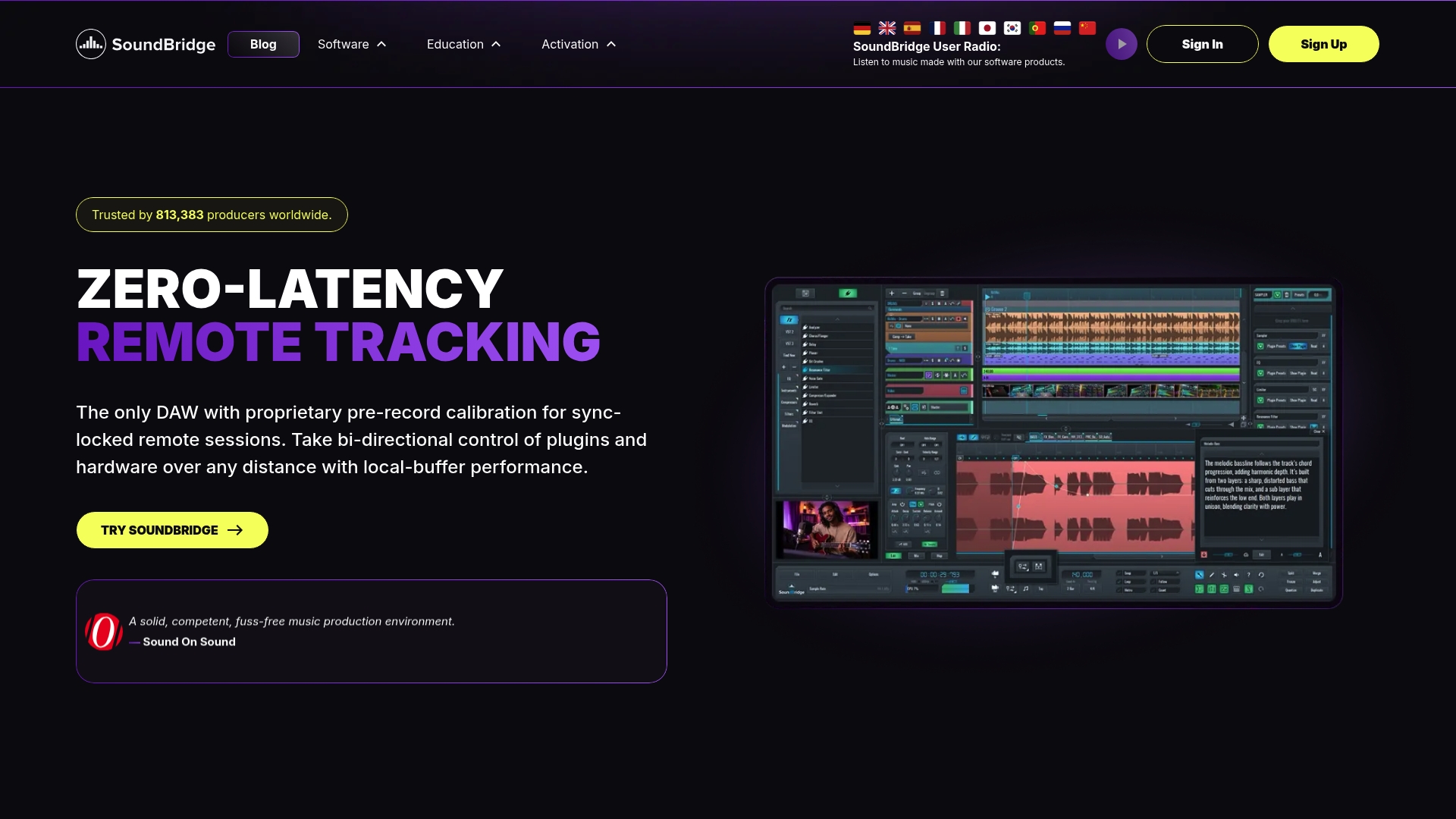
If you’re weighing which DAW can actually support this kind of workflow, SoundBridge’s guide to digital audio workstations walks through the export and collaboration features that matter for session security. Try a session yourself and see where your export hooks would naturally sit.
Frequently Asked Questions
Does blockchain store the actual music file? No. Blockchains store hashes, timestamps, and ownership pointers. The audio itself is stored in decentralized storage systems such as IPFS, Filecoin, or Arweave, with only the resulting content address recorded on-chain.
How does blockchain protect music sessions from theft or disputes? It creates a tamper-evident audit trail. Once a hash and timestamp are registered, that record of who submitted what and when can’t be quietly altered, which gives you evidence if a dispute ever arises over authorship or timing.
What’s the difference between fingerprinting and watermarking? Fingerprinting identifies a file by analyzing its acoustic characteristics, similar to how Shazam matches a song. Watermarking embeds an inaudible marker directly into the audio for provenance, and it tends to survive re-encoding better than a fingerprint alone.
Can smart contracts handle session-level royalty splits automatically? Yes, within limits. Smart contracts can trigger payment splits or licensing terms once verification conditions are met, but they still depend on accurate upstream metadata about who contributed what.
Is a blockchain record admissible as legal evidence? It can support a claim as proof of existence with a timestamp, but its weight in a dispute depends on the jurisdiction and on how rigorously the underlying metadata and verification process were handled.
Sources
- How Blockchain Technology Can Revolutionize the Music Industry
- A Blockchain-Integrated Privacy Framework for Audio Copyright Protection Using ZKP and Attribute-Based Encryption
- Digital transformation, blockchain, and the music industry: A review from the perspective of performers’ collective management organizations
Recommended
MASTER MUSIC PRODUCTION
Expert-led courses designed to take you from fundamentals to finished tracks.

HOUSEFrom bouncy bass and solid kicks, this course teaches you the most modern House music production techniques needed to succeed and stand out.

TRAPQuit sounding like generic Trap and produce something World with hints of the Far East. Create ethnic soundscapes to put your Trap ahead of the curve.

AMBIENTProduce relaxing, sophisticated psy-influenced ambient. Psychedelic and relaxing to listen to, create meditative soundscapes to put your listeners in Zen.