

How to Arrange a Song: A Guide for Songwriters
Last Edited: Jul 7, 2026
Song arrangement is the process of organizing and layering song sections and instruments to create engaging dynamics and emotional flow from start to finish. It differs from song structure in one key way: structure defines what sections exist, while arrangement defines how each section sounds, breathes, and connects. Knowing how to arrange a song separates a compelling track from a forgettable one. This guide covers the core song arrangement techniques used by working producers, from building your first structural map in a DAW to using silence as your most powerful tool.
How to Plan and Map Your Song Arrangement in a DAW
Professional arrangement workflow starts with a structural map, not a polished recording. Before you touch a single plugin or record a final take, drop markers into your DAW that label every section: intro, verse, pre-chorus, chorus, bridge, and outro. This gives you a visual blueprint you can rearrange in seconds without losing any audio.
Most song sections are built around 8-bar increments, and standard pop songs run 3–4 minutes. That math matters. Eight bars at 120 BPM lasts about 16 seconds, which means a two-verse, two-chorus structure fills roughly two minutes before you add a bridge or outro. Knowing this upfront stops you from writing a song that runs seven minutes when your genre calls for three and a half.
Once your markers are in place, build a scratch track. Record rough versions of your main parts, whether that is a chord loop, a drum pattern, or a melody hummed into a microphone. The goal is to test the flow and order of your sections, not to capture a final performance.
- Label every section with a DAW marker before recording anything final.
- Use 8-bar blocks as your default section length, then adjust as needed.
- Build a scratch track with placeholder audio to test pacing and transitions.
- Listen back from the top after placing markers to catch dead zones or awkward jumps.
Pro Tip: Export your scratch arrangement as a rough mix and listen to it on headphones away from your studio. Distance reveals pacing problems that you miss when you are staring at the timeline.
What Techniques Create Dynamic Contrast and Maintain Listener Interest?
Dynamic contrast is the engine of a great arrangement. Without it, every section feels the same, and listeners lose interest fast. The goal is to make each section feel distinctly different in energy, even when the tempo and key stay constant.

One of the most effective tricks is automating the master volume to dip by 1dB to 2dB during verses, then return to 0dB for choruses. The listener’s ear perceives the chorus as a surge of energy without any actual increase in loudness or risk of clipping. This technique costs you nothing and pays off immediately.
The subtraction method is a professional standard that most beginners overlook. You start with all elements playing, then remove instruments in lower-energy sections like verses to create contrast. A verse with just bass, drums, and a single guitar feels intimate. Add keys, backing vocals, and a second guitar for the chorus, and the lift feels enormous.
Silence is the most underrated tool in arrangement. Muting all instruments for a single beat before a chorus creates a vacuum effect that makes the drop hit harder than any riser or effect. Silence beats ear candy almost every time.
- Automate master volume to create perceived energy shifts between sections.
- Use the subtraction method to strip back verses and make choruses explode.
- Apply drum fills and risers at the last two bars of a section to signal a change.
- Drop everything for one beat before a big chorus to maximize impact.
- Carve frequencies between instruments so layers add clarity, not mud.
Pro Tip: Mute your entire arrangement except for the kick and bass before a chorus drop. Bring everything back in on beat one. That one-bar silence will feel like a wall of sound when the full mix returns.
Frequency carving also directly influences perceived energy. When instruments share the same frequency range, they fight each other, and the mix turns muddy. Cutting a narrow band from one instrument to make room for another costs you nothing in perceived volume but adds significant clarity and width.
How Do Song Sections Function and Contribute to Successful Arrangement?
Every section in a song has a specific job. When you understand what each section is supposed to do emotionally, your arrangement decisions become much clearer.
Listener drop-off often occurs within the first 30 seconds, which makes your intro and first verse the most critical real estate in the song. The intro sets the sonic world. The verse builds tension and tells the story. The pre-chorus raises anticipation. The chorus delivers the payoff. Each section earns the next one.
The bridge is a section that many beginners underuse or misunderstand. The bridge provides a total shift to refresh the listener’s ear, offering harmonic, rhythmic, or melodic changes before the final chorus. If your bridge sounds like a quieter verse, it fails its structural purpose. A strong bridge makes the final chorus feel like a revelation rather than a repetition.
Repetition and variation work together to hold attention. Repeating a core musical idea three times builds listener familiarity, and introducing a variation on the fourth iteration keeps engagement alive. This is sometimes called the Rule of Three in arrangement. You can apply it to a chord progression, a melodic hook, or even a rhythmic pattern.
| Section | Primary role | Arrangement tip |
|---|---|---|
| Intro | Establish sonic identity | Keep it short; 4–8 bars maximum |
| Verse | Build narrative and tension | Use fewer layers than the chorus |
| Pre-chorus | Raise anticipation | Add one new element, like a rising synth |
| Chorus | Deliver emotional payoff | Use your fullest arrangement here |
| Bridge | Reset and refresh the listener | Change harmony, rhythm, or texture entirely |
| Outro | Resolve and close | Gradually strip layers or end with a hard cut |
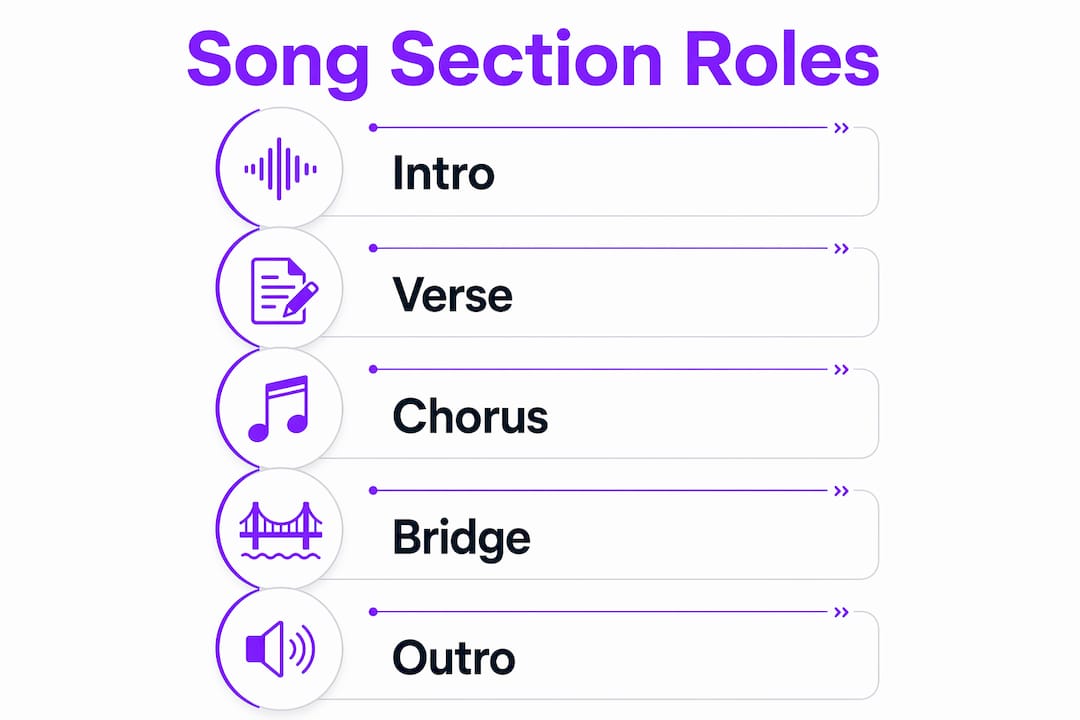
Timing and placement matter as much as content. A chorus that arrives too late loses the listener. A bridge that comes before the second chorus disrupts the payoff. Map your sections against a clock, not just a bar count, to make sure the emotional peaks land where listeners expect them.
Authentic emotional intent drives the best arrangement decisions. The role of authenticity in songwriting shapes how each section connects to the listener, not just how it sounds technically.
Common Mistakes and Troubleshooting Tips When Arranging Songs
Most arrangement problems come from one of two sources: too many layers, or too little variation. Both are fixable with a clear process.
- Over-layering. Adding tracks to fix a problem almost always makes it worse. Keeping your track count under 20 and using frequency carving creates a wider, cleaner sound than stacking parts. Before adding a new element, ask whether removing something would solve the problem instead.
- Production paralysis. Getting stuck perfecting one section before finishing the arrangement is one of the most common traps. Mapping out the song structure with markers and scratch tracks before full production prevents this. Finish the map first, then refine.
- No variation between sections. If your verse and chorus use the same instrumentation and volume, the chorus will not land. Vary at least two elements: add a layer, change the rhythm, or shift the register of your lead melody.
- Ignoring transitions. The two bars before a new section are as important as the section itself. A drum fill, a riser, or a filter sweep signals the change and keeps the listener oriented.
Pro Tip: Solo each section of your arrangement and ask: “Does this section sound complete on its own?” If it does, you have probably over-arranged it. Sections should feel like they need what comes next.
Critical listening is a skill you build deliberately. Mute individual sections and listen to what remains. If the song still makes sense without a part, that part may not be earning its place. This kind of section muting reveals redundant layers faster than any plugin.
Key Takeaways
Effective song arrangement combines structural planning, dynamic contrast, and intentional section design to guide the listener through a complete emotional experience.
| Point | Details |
|---|---|
| Map before you produce | Use DAW markers and scratch tracks to plan structure before recording final parts. |
| Use subtraction for contrast. | Remove elements in low-energy sections, so choruses feel like a genuine lift. |
| Silence creates impact | Muting everything for one beat before a chorus hits harder than any riser. |
| Every section has a job. | Intros establish tone, verses build tension, bridges reset, and choruses deliver payoff. |
| Limit track count | Keeping tracks under 20 and carving frequencies produces a cleaner, wider mix. |
Arrangement Is Architecture, Not Decoration
Arrangement is architectural songwriting. That framing changed how I approach every production. When you think of arrangement as architecture, you stop asking “What can I add?” and start asking “What does this section need to do?” Those are completely different questions, and the second one leads to better music.
The biggest mistake I see from aspiring songwriters is treating arrangement as something you do after the song is written. The arrangement is the song, at least from the listener’s perspective. A great melody buried in a muddy, shapeless arrangement will lose to a simple hook that breathes and builds correctly.
My honest advice: resist the “more is more” instinct. Every time you feel the urge to add a new layer, try removing one instead. The emotional storytelling in music that connects with listeners almost always comes from space and intention, not density. The producers who understand this early develop a personal style faster than anyone else.
Experiment with your transitions before you finalize anything else. A single bar of silence, a reversed crash cymbal, or a filter sweep can transform a flat arrangement into one that feels alive. Your ear will tell you when it is right. Trust that instinct, then back it up with the techniques above.
— Wake
SoundBridge and Your Arrangement Workflow
Putting these techniques into practice requires a DAW that keeps up with your creative process. SoundBridge gives you marker management, track organization, and audio processing tools to build and refine your arrangement from the first sketch to the final mix.

SoundBridge supports 192kHz sample rates and zero-latency remote tracking, so your arrangement sessions stay accurate whether you are working solo or with collaborators across the world. The platform’s intuitive interface makes it easy to drop markers, build scratch tracks, and iterate quickly without losing momentum. If you are new to working in a DAW, the complete DAW guide on SoundBridge covers everything you need to get your arrangement workflow up and running. You can also sharpen your editing skills with the essential audio editing techniques guide to complement your arrangement practice.
FAQ
What is song arrangement in music production?
Song arrangement is the process of organizing song sections and layering instruments to create dynamic flow and emotional impact. It differs from song structure in that it determines how each section sounds, not just which sections exist.
How do I structure a song for maximum listener engagement?
Build your arrangement around 8-bar increments and place your most energetic section, the chorus, after a clear buildup through verse and pre-chorus. Listener drop-off often occurs within the first 30 seconds, so make your intro and first verse count.
What is the subtraction method in song arrangement?
The subtraction method starts with all instruments playing, then removes elements in lower-energy sections like verses to create contrast. This makes the chorus feel like a genuine lift without adding new tracks.
How does the bridge function in a song arrangement?
The bridge provides a harmonic, rhythmic, or melodic shift that refreshes the listener’s ear before the final chorus. If the bridge does not offer a clear contrast, it fails its structural purpose, and the final chorus loses impact.
How many tracks should a song arrangement have?
Keeping your track count under 20 and using frequency carving produces a cleaner, wider mix than stacking layers. Fewer tracks, with intentional frequency placement, create greater clarity and perceived energy than a cluttered arrangement.
Recommended
MASTER MUSIC PRODUCTION
Expert-led courses designed to take you from fundamentals to finished tracks.

HOUSEFrom bouncy bass and solid kicks, this course teaches you the most modern House music production techniques needed to succeed and stand out.

TRAPQuit sounding like generic Trap and produce something World with hints of the Far East. Create ethnic soundscapes to put your Trap ahead of the curve.

AMBIENTProduce relaxing, sophisticated psy-influenced ambient. Psychedelic and relaxing to listen to, create meditative soundscapes to put your listeners in Zen.