

Loudness Normalization: A Mixing and Mastering Guide
Last Edited: Jul 13, 2026
Loudness normalization is defined as the process of adjusting audio gain based on perceived loudness, measured in LUFS (Loudness Units Full Scale), to deliver consistent playback volume across streaming platforms and broadcast systems. Unlike peak normalization, which targets the highest sample value, loudness normalization targets how loud audio actually sounds to human ears. Standards like ITU-R BS.1770, EBU R128, and ATSC A/85 govern this process across regions and delivery formats. Streaming platforms typically target around -14 to -16 LUFS, while broadcast TV operates at -23 to -24 LUFS with true peak ceilings between -1 and -2 dBTP. Knowing these targets before you mix saves you from costly revisions at the mastering stage.
What are the key loudness metrics used in normalization?
LUFS and LKFS are the same measurement expressed under different standards. LUFS comes from EBU R128, while LKFS appears in ITU-R BS.1770 and ATSC A/85. Both reflect K-weighted, frequency-sensitive loudness that correlates with human perception far better than raw peak levels. That distinction matters because a bass-heavy track and a bright pop mix can share the same peak level but sound dramatically different in volume.
Four metrics define a complete loudness measurement:
- Integrated Loudness (I): The average loudness of an entire program, measured in LUFS. This is the primary delivery target for streaming and broadcast.
- Loudness Range (LRA): The statistical spread between quiet and loud sections, measured in LU. EBU R128 recommends a maximum LRA of 18 LU for broadcast content.
- True Peak (TP): The reconstructed peak level after digital-to-analog conversion, measured in dBTP. Standard practice sets the ceiling at -1 dBTP.
- Momentary and Short-Term Loudness: Snapshot measurements over 400ms and 3 seconds respectively, useful for identifying problem sections during mixing.
The governing standards differ by region and application:
| Standard | Target Loudness | True Peak Ceiling | Primary Use |
|---|---|---|---|
| EBU R128 | -23 LUFS | -1 dBTP | European broadcast |
| ATSC A/85 | -24 LKFS | -2 dBTP | North American broadcast |
| Streaming (general) | -14 to -16 LUFS | -1 dBTP | Spotify, YouTube, Apple Music |
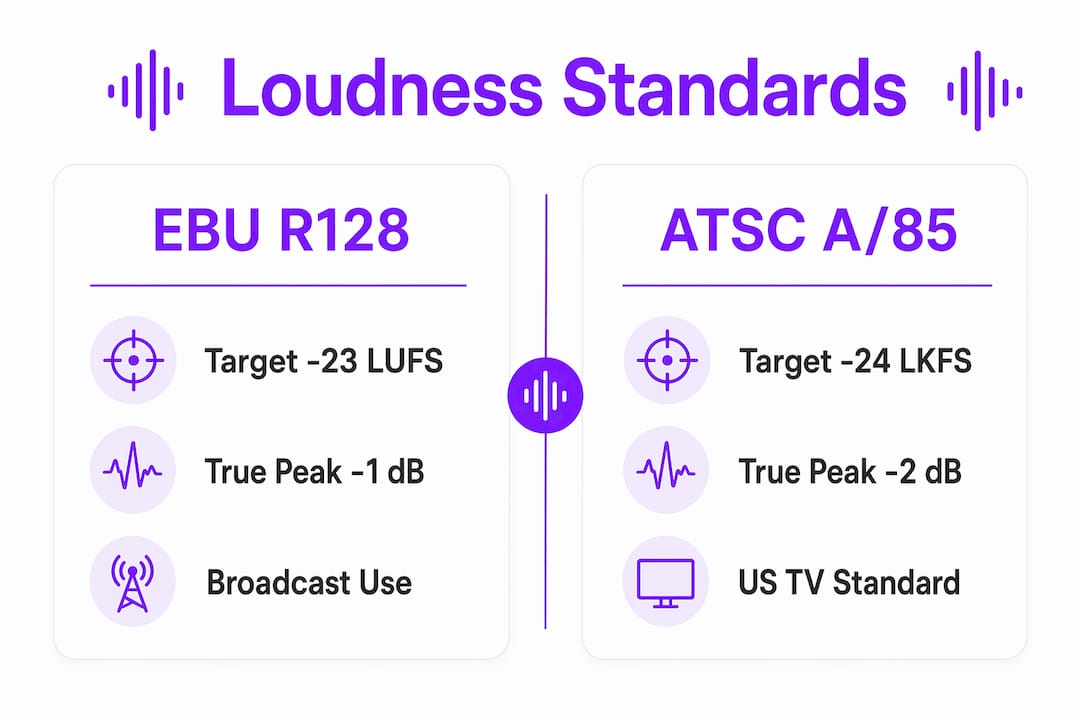
EBU R128 targets -23 LUFS with a maximum Loudness Range of 18 LU, while ATSC A/85 sets -24 LKFS with stricter peak limits for North American broadcast. The gap between broadcast and streaming targets is significant. A master optimized for Spotify at -14 LUFS will be turned down by 9 dB when delivered to a broadcast chain targeting -23 LUFS.
How do engineers apply loudness normalization in mixing and mastering?
The workflow follows a clear sequence. Skipping steps or reversing their order produces results that fail platform checks or sound worse after normalization is applied downstream.
- Mix with headroom. Keep your mix peaks between -6 and -3 dBFS. This leaves room for the mastering chain without forcing the limiter to work too hard.
- Apply a true peak limiter. Set the ceiling at -1 dBTP. Standard limiters measure sample peaks, not inter-sample peaks, so you need a true peak-aware limiter to prevent distortion after digital-to-analog conversion.
- Measure integrated loudness. Use a loudness meter that reads LUFS, not just dBFS. Run the full program through the meter to get an accurate integrated loudness reading.
- Calculate the gain adjustment. Subtract your measured integrated loudness from the target. If your master reads -18 LUFS and your target is -14 LUFS, you need +4 dB of linear gain.
- Apply linear gain, not compression. Normalization applies a static gain change to reach the target. Adding compression at this stage changes the dynamic character of the mix, which is a separate creative decision.
- Verify true peak compliance. After the gain adjustment, re-check your true peak reading. A +4 dB gain increase may push peaks above -1 dBTP and require limiter adjustment.
- Quality control the full program. Listen to the normalized master in context. Check that quiet passages do not expose noise floor issues and that transients still punch through.
Pro Tip: Use a two-pass loudness normalization approach for broadcast deliveries. The first pass measures exact integrated loudness, LRA, and true peak values. The second pass applies the precise gain needed. Two-pass normalization produces broadcast-grade accuracy without any unintended compression artifacts.
The step-by-step audio editing process matters as much as the tools you use. A clean mix with good headroom makes every downstream step easier and more predictable.
What is the difference between loudness normalization, peak normalization, and compression?
These three processes are often confused, but they solve different problems and produce different results.
Peak normalization raises or lowers a file so its loudest sample hits a target level, typically 0 dBFS. The problem is that peak level does not reflect perceived loudness. A heavily compressed track with a peak at 0 dBFS can sound twice as loud as a dynamic orchestral recording with the same peak. Peak normalization is useful for preventing clipping, but it does not solve the consistency problem across platforms.
Loudness normalization adjusts overall gain to hit a LUFS target. Humans perceive loudness subjectively with frequency sensitivity, which is why K-weighted LUFS measurements correlate with perception far better than peak values. Loudness normalization does not touch the dynamic shape of the audio. It simply moves the entire signal up or down by a fixed number of dB.
Dynamic range compression is a separate process entirely. Compression modulates signal level in real time, reducing the gap between loud and quiet moments. It changes the texture and feel of audio. Normalization adjusts overall gain; compression modulates signal level dynamically to control peaks and dynamic range. These are not interchangeable.
Key distinctions to keep in mind:
- Loudness normalization preserves dynamic range. Compression reduces it.
- Peak normalization targets the highest sample. Loudness normalization targets perceived average loudness.
- Compression is a creative and corrective tool applied during mixing and mastering. Normalization is a delivery compliance step.
- Platforms apply loudness normalization automatically. They do not apply compression to your master.
When your mix has excessive dynamic range for a specific format, apply upward and downward compression before the normalization step. Compression shapes the dynamics. Normalization sets the final level.
How do platform loudness standards affect your audio delivery?
Every major streaming platform and broadcast chain applies its own loudness normalization to incoming content. Understanding each target protects your mix from sounding worse after delivery than it did in your studio.
Spotify and YouTube both target approximately -14 LUFS. Apple Music targets -16 LUFS. European broadcast under EBU R128 targets -23 LUFS. North American broadcast under ATSC A/85 targets -24 LKFS. Each platform also enforces a true peak ceiling, typically -1 dBTP for streaming and -2 dBTP for broadcast.
The critical behavior to understand is directional. Streaming platforms apply downward normalization to content louder than their targets. They generally do not boost quieter content, because boosting raises the noise floor. A master at -8 LUFS delivered to Spotify gets turned down by 6 dB. That gain reduction exposes any noise, reduces the perceived punch of transients, and often makes the mix sound flat compared to a dynamic master delivered at -14 LUFS.
Pro Tip: Deliver separate masters for different platforms when the loudness gap is large. A broadcast master at -23 LUFS and a streaming master at -14 LUFS can both sound excellent when mastered to their respective targets. Trying to split the difference with one master produces a result that is suboptimal for both.
Loudness meter tools are non-negotiable for this workflow. A meter that displays integrated LUFS, LRA, and true peak simultaneously gives you a complete picture before export. Many professional meters also include platform-specific presets that show you exactly where your master sits relative to Spotify, YouTube, Apple Music, and broadcast targets in one view.
For audio professionals delivering content across multiple formats, understanding best practices for podcast mixing also reinforces loudness discipline, since podcast platforms apply their own normalization targets that differ from music streaming services.
The audio mastering workflow you build around these targets determines whether your music translates across every listening environment or loses its impact the moment a platform touches it.
Key Takeaways
Loudness normalization is a gain-based delivery process governed by LUFS targets and standards like EBU R128 and ATSC A/85, and mastering to these targets preserves dynamics while ensuring consistent playback across every platform.
| Point | Details |
|---|---|
| LUFS is the core metric | Measure integrated loudness in LUFS, not dBFS, to hit platform and broadcast targets accurately. |
| Standards vary by region | EBU R128 targets -23 LUFS; ATSC A/85 targets -24 LKFS; streaming platforms target -14 to -16 LUFS. |
| True peak limiting is mandatory | Set your true peak limiter ceiling at -1 dBTP to prevent inter-sample clipping after conversion. |
| Normalization is not compression | Loudness normalization applies a static gain change; compression modifies dynamic range dynamically. |
| Loud masters lose impact | Masters pushed above platform targets get turned down, exposing noise and reducing punch. |
Why chasing LUFS numbers misses the point
The most common mistake I see from producers is treating the LUFS target as a creative goal rather than a delivery specification. Targets are for playback systems, not creation stages. When you master with the intention of hitting -14 LUFS as a loudness achievement, you end up compressing and limiting until the life drains out of the mix.
The better frame is this: master for the music first, then check compliance. A dynamic master at -16 LUFS delivered to Spotify sounds better than an over-limited master at -14 LUFS, because the platform will not penalize the quieter master. Masters pushed to extremes like -6 LUFS get turned down by streaming services, losing impact compared to dynamic masters sitting near the platform target.
True peak limiting is where I see the second major error. Engineers use standard limiters and assume they are compliant. Standard limiters catch sample peaks. They miss inter-sample peaks, which are the values that appear after the digital-to-analog converter reconstructs the waveform. A file that reads -0.3 dBFS on a sample-level meter can clip after conversion. Always use a true peak-aware algorithm and set the ceiling at -1 dBTP.
My practical advice: run a two-pass measurement on every critical delivery. Measure first, apply gain second. Never guess. The two-pass method gives you exact values and keeps your dynamic range intact. That discipline, more than any plugin or preset, separates professional deliveries from amateur ones.
— Wake
Soundbridge and your loudness workflow
Soundbridge is built for producers and engineers who take audio quality seriously. Its high-fidelity processing at up to 192kHz sample rates gives you the resolution to make accurate loudness decisions at every stage of your mix and master.
Whether you are learning the fundamentals of audio editing techniques or building a full mastering chain inside a professional DAW, Soundbridge gives you the tools and the environment to do it right. The platform supports both Mac and Windows, with free and paid tiers so you can start building your loudness-compliant workflow today. If you are new to DAWs or looking to upgrade your setup, the 2026 DAW guide is the best place to understand how Soundbridge fits your production needs.
FAQ
What is LUFS and why does it matter for loudness normalization?
LUFS (Loudness Units Full Scale) measures perceived loudness using K-weighted frequency analysis, making it far more accurate than peak-level measurements. Streaming platforms and broadcast standards use LUFS targets to normalize playback volume consistently across all content.
What loudness target should I master to for Spotify and YouTube?
Both Spotify and YouTube target approximately -14 LUFS for normalized playback, with a true peak ceiling of -1 dBTP. Mastering close to this target preserves your dynamic range and avoids the gain reduction that louder masters receive.
How is loudness normalization different from peak normalization?
Peak normalization adjusts a file so its loudest sample hits a set level, while loudness normalization adjusts gain based on perceived average loudness measured in LUFS. Peak normalization does not account for how loud audio actually sounds to human ears.
Does loudness normalization affect dynamic range?
Loudness normalization applies a static gain change and does not alter dynamic range. If you need to control dynamic range before delivery, apply compression separately during the mixing or mastering stage before running loudness normalization.
What is a true peak limiter and do I need one?
A true peak limiter uses inter-sample peak detection to catch clipping that occurs after digital-to-analog conversion, which standard limiters miss. Setting the ceiling at -1 dBTP with a true peak-aware limiter is the broadcast and streaming industry standard for compliant delivery.
Recommended
MASTER MUSIC PRODUCTION
Expert-led courses designed to take you from fundamentals to finished tracks.

HOUSEFrom bouncy bass and solid kicks, this course teaches you the most modern House music production techniques needed to succeed and stand out.

TRAPQuit sounding like generic Trap and produce something World with hints of the Far East. Create ethnic soundscapes to put your Trap ahead of the curve.

AMBIENTProduce relaxing, sophisticated psy-influenced ambient. Psychedelic and relaxing to listen to, create meditative soundscapes to put your listeners in Zen.