

Studio Engineers: Pitch Shifting Without Artifacts Using STN & AI
Last Edited: Oct 5, 2026
Pitch shifting without artifacts comes down to four choices: pick your algorithm by source material (PSOLA for solo vocals, phase vocoder for polyphonic mixes), work at higher sample rates with real headroom, apply formant correction independently of pitch, and preserve transients with STN decomposition before you commit to a big shift. Blend in a little dry signal on aggressive moves. High-resolution engines and phase-vocoder tools give you the room to do all four without guesswork.
TL;DR:
- Phase vocoders are best for polyphonic materials like full mixes, but they risk phasiness if not tuned properly with larger FFT sizes and high overlap.
- PSOLA excels at monophonic vocals and solo instruments by maintaining transients but fails on dense polyphony or complex textures.
- Applying independent formant correction and reapplying transients can significantly reduce artifacts, especially on expressive vocals and harmonic instruments.
- Using higher sample rates (96 or 192 kHz) and blending in dry signals improves artifact-free pitch shifting and preserves clarity on critical sources.
- Offline processing with high-resolution engines and careful parameter choice remains essential for the highest quality, especially on complex, genre-sensitive material.
What Causes Pitch-Shifting Artifacts?
Every pitch-shift artifact traces back to one of three failures: bad phase math, smeared transients, or formants that move when they shouldn’t.
Phasiness shows up in frequency-domain methods when the algorithm can’t correctly unwrap phase relationships between bins. The result is a hollow, swirly quality, worst on sustained pads and vocal tails where the ear has time to notice the smear. Laroche and Dolson’s foundational phase vocoder analysis documents precisely how this modulation noise accumulates across frames.
Transient smearing occurs because most pitch-shifting engines assume that a signal is quasi-stationary from one frame to the next. A snare hit or a plosive consonant isn’t stationary at all. Treat it like one, and the attack turns soft and diffuse.
Formant shift is the third failure, and it’s the one people notice fastest. Shift pitch up without correcting the formants, and your voice turns into a chipmunk; shift down without correcting, and you get the “giant” effect. That’s because pitch and formant are entirely separate parameters, a distinction the Sonarworks formant-shifting guide lays out clearly.
Monophonic sources, like a single voice or a melodic bassline, tolerate aggressive processing far better than polyphonic material, where overlapping harmonics cause phase errors to compound quickly.
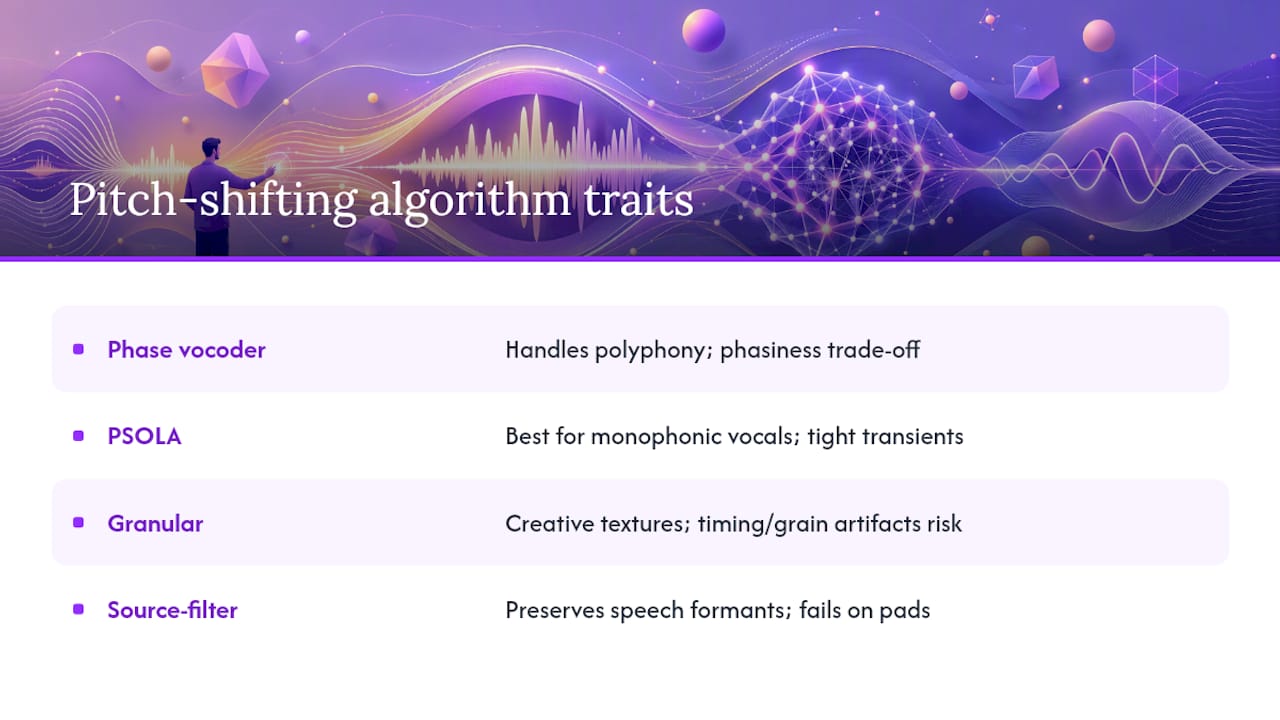
Phase Vocoder vs. PSOLA vs. Granular vs. Source-Filter
Choosing the right algorithm family matters more than any single parameter tweak. Each approach solves the artifact problem differently, and each breaks down under different conditions.
Phase vocoder methods work in the frequency domain and handle polyphonic material, chords, full mixes, and orchestral sections better than any time-domain method. Phasiness is the trade-off, but it’s manageable: phase-locking, a larger FFT size, and higher overlap percentages dramatically reduce the worst-case modulation sidebands, according to Laroche and Dolson’s analysis.
PSOLA (pitch-synchronous overlap-add) and other time-domain, pitch-marking methods are the low-artifact champion for monophonic vocals and solo instruments. It tracks individual pitch periods directly rather than reconstructing spectra, which keeps transients tight. Feed it dense polyphony, though, and it falls apart quickly, according to a comparative analysis by Tonalux.
Granular and sample-based shifting takes a different route entirely, chopping audio into grains and reassembling them at a new pitch. It can dodge some classic artifacts but often introduces its own timing grain and texture shifts, useful creatively, risky when transparency is the goal.
LPC and source-filter models separate the excitation signal from the resonant filter, which makes them excellent at preserving speech formants. They tend to fail on pure tones and sustained synth pads where there’s no clear source-filter structure to model.
Real-time work forces compromises on all four families since low latency limits FFT size and lookahead. Offline rendering removes that ceiling entirely.
How to Set Up a DAW Session for Clean Pitch Shifts
Getting artifact-free results in a session is a matter of sequence, not luck. Follow this order, and you’ll catch most problems before they compound.
- Prep the project first. Work at 96 or 192kHz when your source and CPU allow it. Higher sample rates give the algorithm more spectral resolution to work with, and clean, headroom-rich source audio (no clipping, minimal background noise) gives it less garbage to amplify.
- Pick the algorithm by source type. Solo vocal or monophonic instrument, reach for PSOLA or a time-domain pitch tracker. Full mix, chord stack, or dense polyphony, go phase vocoder.
- Tune the frequency-domain settings. A Hann window with 75% overlap keeps amplitude-modulation sidebands roughly 30 dB quieter than 50% overlap in worst-case fractional shifts, per Laroche and Dolson’s data. Larger FFT sizes improve frequency resolution but cost you time resolution, so match FFT size to the material: larger for sustained pads, smaller for percussive content.
- Isolate and reapply transients. Run an STN (sines, transients, noise) or transient-detection pass before shifting, then reintroduce the transient layer afterward. This single step does more to eliminate smeared attacks than any other adjustment.
- Correct formants independently. Start with subtle formant adjustments and listen carefully before making larger changes.
- Blend in dry signal for big shifts. Anything beyond a few semitones benefits from 10 to 20% of the original dry track mixed underneath the processed signal.
- Automate wet/dry on problem passages rather than committing to one blend for the whole part.
- Verify by rendering and A/B’ing against the dry original at matched loudness, ideally through more than one monitoring source.
Pro Tip: Render your pitch-shifted pass at a slightly higher internal sample rate than your project, then downsample on export. That extra resolution during processing gives frequency-domain algorithms more room to avoid aliasing artifacts, and the difference is audible on vocal-heavy material.
How Do You Preserve Formants When Shifting Pitch?
Independent formant control exists because pitch and formants are governed by entirely different acoustic mechanisms: the vocal cords set pitch, the vocal tract shape sets formants, and a shift that moves both together destroys the character of a voice or instrument almost immediately beyond a couple of semitones.
Start conservative. A 10-20% formant adjustment is a safe testing baseline according to Sonarworks, and it’s enough to correct the chipmunk or giant effect during moderate pitch shifts. For deliberate character transformation, typical ranges for feminine and masculine timbres exist, but these depend heavily on the source and should be used as general guides rather than fixed settings.
Processing order matters as much as the numbers. Apply formant correction before compression, EQ, and reverb, not after, since those effects will emphasize whatever formant errors are already baked in (Baby Audio’s formant-shifting guide makes the same point about testing changes in context rather than in isolation).
For extreme transformations, a resynthesis or vocoder-based approach usually outperforms a plugin-based formant shifter, since it rebuilds the spectral envelope rather than stretching an existing one.
What Do STN Decomposition and AI Restoration Offer in 2026?
The most useful recent advance in pitch shifting is to treat a signal as three separate problems rather than one. STN decomposition splits audio into sines, transients, and noise, then applies a specialized process to each: the frequency-domain engine handles the sine content; transients are detected and reinserted after processing, rather than being smeared through it; and noise is handled via time-scaling and resampling rather than spectral manipulation. A DAGA 2025 paper on low-latency STN pitch-shifting documents an online implementation of exactly this pipeline, with measurably cleaner results on polyphonic material.
- STN pipelines reintroduce transients after pitch processing rather than letting frames smear them.
- Noise components get time-scaled and resampled instead of forced through frequency-domain math built for tonal content.
- A practical tonality limit lets frequency scaling track the pitch-shift factor only up to a corner frequency, then holds 1:1 above it to protect high-frequency timbre, a compromise the DAGA paper describes directly.
A recent restoration-based approach takes a different route: it uses the WORLD vocoder to obtain a stable pitch estimate, then runs a shallow diffusion denoiser to clean up artifacts while preserving that pitch. Both approaches need tuning and add latency, so reserve them for offline, critical vocal work rather than real-time performance.
How Do Artifacts Differ Across Audio Contexts?
A piano chord and a spoken-word sample tolerate completely different amounts of pitch-shift damage before a listener notices, and knowing where the perceptual thresholds sit changes how aggressively you can push a shift.
Sustained, harmonically rich material — strings, pads, vocal held notes — exposes phasiness fastest. The ear has time to lock onto the swirl, so even a shift of two or three semitones can sound wrong if the phase vocoder settings aren’t tight.
Percussive and transient-heavy material, drums, plucked strings, consonant-heavy speech, exposes smearing fastest instead. Phasiness barely registers on a kick drum; a softened, splashy transient does immediately.
Dense polyphonic mixes mask artifacts more effectively than solo instruments simply because there’s more competing information for the ear to sort through. A shifted background pad buried under a full arrangement can get away with settings that would sound unusable on an exposed solo cello line.
Speech and vocals sit in their own category because listeners have a lifetime of exposure to what a natural human voice sounds like. Formant errors that would go unnoticed on a synth patch are instantly obvious on a voice, which is why vocal-focused workflows deserve the most conservative settings and the most careful A/B checking. Genre matters too: electronic and hip-hop production has built entire aesthetics around audible pitch artifacts, while acoustic genres, jazz, folk, and orchestral music demand transparency because audiences expect realism.
How Can You Mask Residual Artifacts After Processing?
Even a well-executed pitch shift sometimes leaves a trace, and that’s where post-processing earns its place in the chain.
EQ is the first tool worth reaching for. A gentle high-shelf cut above 8 to 10kHz can tame the thin, brittle quality that phase vocoder artifacts often leave in the upper harmonics, without dulling the whole track. On the low end, a narrow cut around any resonant buildup from formant correction can clean up mud that wasn’t there in the source.
Dynamic processing works differently but complements EQ well. Light compression evens out any residual amplitude modulation from phase-vocoder sidebands, smoothing the pumping that can be introduced by phasiness on sustained notes. Serial compression across two gentle stages tends to control this more transparently than a single aggressive compressor stage, since each pass has only to do a small amount of work.
Saturation and subtle harmonic distortion can also help, oddly enough. A touch of analog-style saturation adds low-order harmonics that give the ear something coherent to latch onto, which can mask thin or artificial-sounding upper partials left behind by aggressive shifts.
Reverb and delay are the last line of defense. A short room reverb or a subtle slapback can blur the line between what’s natural and what’s processed, especially useful on background vocal stacks where transparency matters less than blend. None of these techniques fix an artifact at its source; they make it less audible in context, so always solve the problem upstream first and treat post-processing as insurance, not a repair shop.
What Makes Real-Time Pitch Shifting Harder?
Real-time pitch shifting fights a physics problem that offline rendering never has to face: latency. A phase vocoder needs a window of future samples to compute its FFT; the larger the window, the better the frequency resolution, but also the longer the delay before you hear the result. Live performance, gaming audio, and voice-changer applications all need latency low enough that a performer doesn’t notice the lag between singing a note and hearing it shifted back.
That constraint forces smaller FFT sizes than you’d choose for a mastering pass, which means less frequency resolution and more visible phasiness on sustained tones. Overlap percentages often get trimmed too, since more overlap means more computation per unit of time, a real cost when a CPU has milliseconds, not seconds, to work with.
Transient handling suffers the most under real-time constraints. STN-style decomposition, which depends on detecting a transient before deciding how to treat it, needs at least a little lookahead to work reliably. Real-time systems either accept some transient smearing as the cost of low latency, or they use lightweight, low-lookahead transient detectors that catch less than a full offline analysis would.
The practical fix is triage: accept a small compromise on sustained, harmonically complex material during live performance, and reserve the highest-quality algorithm settings for anything you can render offline. A vocal effects processor running live on a stage vocal doesn’t need the same fidelity as a lead vocal you’re printing for a final master.
How Have Producers Reduced Artifacts Across Genres?
Genre expectations shape how much artifact tolerance a project actually needs, and choices shift dramatically once you look at real production contexts.
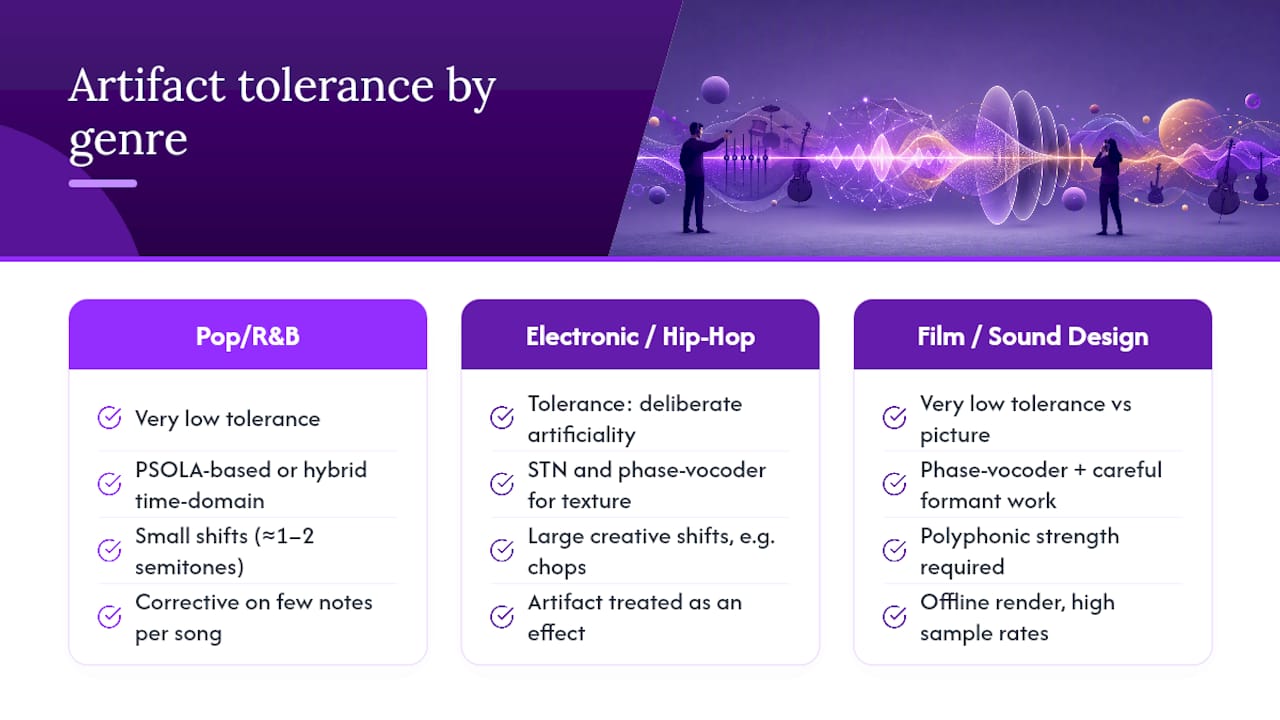
Pop and R&B vocal production leans heavily on subtle pitch correction and harmony generation, aiming for transparency. Engineers in this space favor PSOLA-based or hybrid time-domain approaches specifically because the shifts involved are usually small, a semitone or two of correction, and any audible artifact undermines the illusion that the vocal was always in tune. Producers researching this space often find that even a naturally gifted vocalist benefits from corrective processing on a handful of notes per song, which is a different job than the large-interval creative shifts discussed elsewhere in this guide.
Electronic and hip hop production takes the opposite stance in places, deliberately pushing pitch shifts into audibly artificial territory for effect: chipmunk-soul vocal chops, pitched-down trap ad-libs, granular-textured leads. Here the “artifact” becomes the aesthetic, and the STN and phase-vocoder techniques covered above get used to control how artificial something sounds rather than to eliminate the artifact entirely.
Film scoring and sound design sit at the demanding end of the spectrum. A composer transposing an orchestral stem or reshaping a creature vocalization needs the phase vocoder’s polyphonic strength combined with careful formant work, since a shifted string section that sounds even slightly phasy will read as artificial against picture. This is exactly the kind of work where offline rendering, high sample rates, and STN-style transient preservation are worth the processing time.
Rules of Thumb Worth Memorizing
Keep every adjustment as small as the arrangement allows, and re-record rather than shift whenever that option exists. When a big move is unavoidable, blend in dry signal and run your final pass offline rather than live. Match the algorithm to the source every time, never the reverse.
— Wake
Cleaner Pitch Shifts Start With the Right DAW
Some DAWs process audio at up to 192kHz, giving frequency-domain algorithms spectral headroom to avoid phasiness and formant smearing covered throughout this guide. High-fidelity engines and time-stretching tools are built for demanding work, whether correcting a vocal take or transposing a full orchestral stem for a score.

If you want to put these techniques into practice, the product page walks through the full feature set, including the audio engine behind the pitch and formant tools discussed here. Two tutorials are worth following alongside this guide: bending pitch with delay for tape-style modulation effects and serial compression for cleaner, more controlled vocals after a pitch shift. Start with a free version to reproduce the workflow from this article, then consider premium or lifetime licenses for full-resolution rendering on real sessions.
Sources
- Restoration-based approaches for artifact-resistant pitch shifting (arXiv)
- Formant Shifting Explained: Changing Gender and Character in AI Vocals - Sonarworks Blog
FAQ
Does Taylor Swift Use Pitch Correction?
Most professional pop vocal production, across the industry and not any one artist specifically, includes some degree of pitch correction, typically subtle, corrective work on isolated notes rather than a full-track effect. The goal in mainstream pop is usually transparency, which is why PSOLA-style and hybrid correction tools stay popular for lead vocals.
Does Pitch Shifting Avoid Copyright?
No. Shifting the pitch of a copyrighted recording doesn’t change who owns it or remove the need for a license; copyright protection covers the underlying composition and recording regardless of how much the pitch or tempo has been altered. Always clear rights before releasing or monetizing pitch-shifted material that uses someone else’s recording.
What Is the Best Free Pitch Shifting Plugin?
There isn’t a single universal answer, since the right free tool depends on your source material and whether you need PSOLA-style monophonic accuracy or phase-vocoder handling for polyphonic content. SoundBridge’s Free Version includes time-stretching and pitch tools that cover the core workflow described in this guide, which makes it a solid starting point for testing techniques before committing to a paid tier.
How Do You Pitch Shift Without Losing Quality?
Match your algorithm to the source: PSOLA for monophonic vocals, phase vocoder for polyphonic mixes, and work at the highest sample rate your project allows. Layer in independent formant correction, preserve transients with an STN or transient-detection pass, and blend a little dry signal back in on any shift larger than a few semitones.
Recommended
MASTER MUSIC PRODUCTION
Expert-led courses designed to take you from fundamentals to finished tracks.

HOUSEFrom bouncy bass and solid kicks, this course teaches you the most modern House music production techniques needed to succeed and stand out.

TRAPQuit sounding like generic Trap and produce something World with hints of the Far East. Create ethnic soundscapes to put your Trap ahead of the curve.

AMBIENTProduce relaxing, sophisticated psy-influenced ambient. Psychedelic and relaxing to listen to, create meditative soundscapes to put your listeners in Zen.