

Self-Hosted Music Collaboration Servers: 2026 Guide
Last Edited: Aug 2, 2026

For most musicians, a Docker-based studio/project stack is the right starting point for self-hosted music collaboration. It gives you full control over your audio files, versioning, and project comments without depending on any third-party platform. If you’d rather skip the admin work entirely and get studio-accurate remote tracking from day one, SoundBridge is the managed alternative worth considering.
Three paths exist, and each fits a different workflow:
- Lightweight library servers (OpenSubsonic-compatible, e.g., Navidrome): best for solo artists or small teams who need remote access to a music library with broad mobile client support.
- Federated pods (ActivityPub-enabled, e.g., Funkwhale): best for creators who want decentralized social discovery alongside catalog hosting.
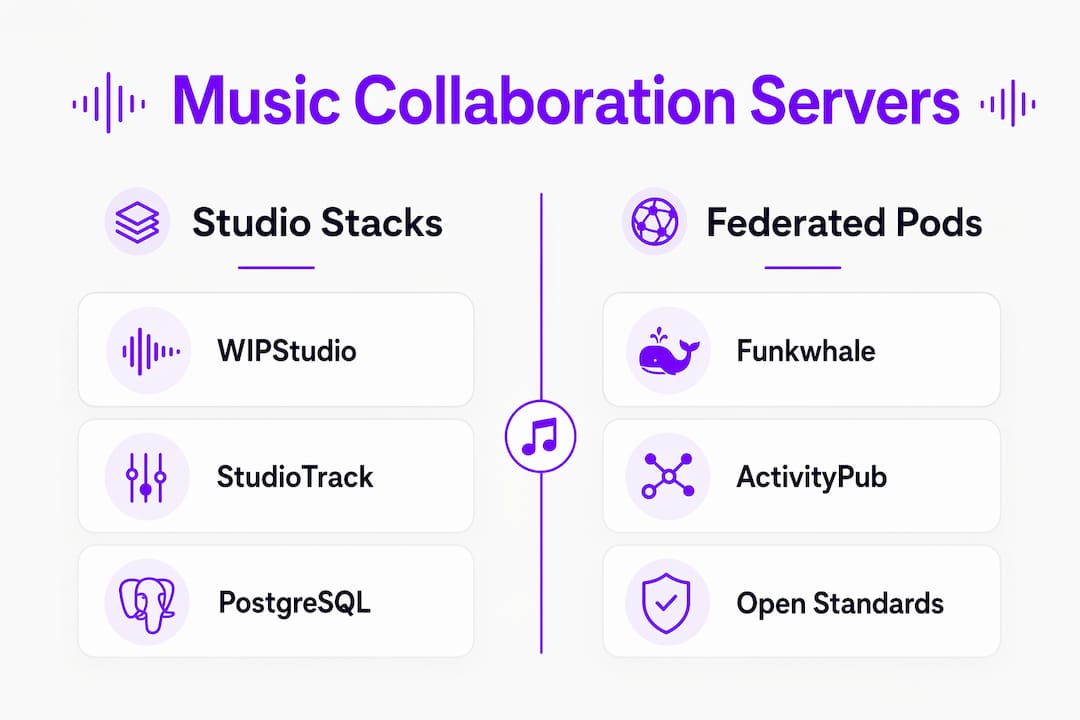
- Studio/project stacks (Docker + PostgreSQL + S3-compatible storage, e.g., WIPStudio, StudioTrack, NextSound): best for teams doing real project-based collaboration with timestamped comments, file versioning, and project management.
The core trade-off is simple: privacy and control cost you admin time. You own the data; you also own the SSL certificates, the backups, and the uptime. Project-based collaboration is well-supported by self-hosted tools. True low-latency live jamming across geographic distances is constrained by physics, not software.
Quick decision checklist before you pick a path:
- How many collaborators? Under 10 is manageable on a single VPS; beyond that, plan for horizontal scaling.
- Do you need real-time audio? If yes, proximity matters. Collaborators located far apart geographically will experience noticeable lag.
- Are you willing to manage backups, SSL, and updates yourself?
- What’s your budget and timeline? A basic Docker stack can be up and running in under a few hours.
Must-have collaboration features to look for: timestamped waveform comments, file versioning with changelog notes, project management (tracks, versions, metadata), and user role controls.
Pro Tip: Before committing to any self-hosted stack, spin up a test instance locally with Docker Desktop. You’ll surface configuration gaps in 30 minutes rather than discovering them mid-session with a collaborator.
Which Self-Hosted Music Collaboration Server Fits Your Setup?
| Tool / Category | Best Use Case | Collaboration Features | Federation / ActivityPub | Ease of Self-Hosting | Client Compatibility | License / Cost |
|---|---|---|---|---|---|---|
| SoundBridge | Zero-admin studio-grade remote sessions | Real-time tracking, video, talkback | No (managed hosted) | No setup required | Native DAW clients | Free + paid tiers |
| Studio/project stacks (WIPStudio, StudioTrack) | Project collaboration, versioning | Timestamped comments, versioning, project mgmt | No | Docker + PostgreSQL + S3 | Web UI | Open source / varies |
| Federated pods (Funkwhale) | Social discovery + catalog hosting | Basic comments, follows | Yes (ActivityPub) | Docker image available | Web + some mobile | AGPL, free |
| Lightweight library servers (Navidrome) | Remote music library access | Minimal | No | Docker, low resource | OpenSubsonic API, mobile | GPL, free |
| WebSocket rooms (Tunecamp, NextSound) | Synchronized listening/feedback | Waveform comments, versioning (NextSound) | No | Docker (NextSound) | Web browser | Open source, free |
Studio/Project Stacks: Wipstudio and Studiotrack
These are the workhorses for teams doing real asynchronous production work. A typical stack combines a container image, PostgreSQL for metadata and project state, and either S3-compatible object storage or local persistent volumes for audio files. StudioTrack adds cloud-relay tunnels so collaborators can reach your instance without VPN or manual port forwarding. Expect a setup timeline of a few hours for a clean deployment. Put Caddy or Nginx in front for TLS; without it, you’re exposing audio files over plain HTTP.
Federated Pods: Funkwhale
Funkwhale implements ActivityPub, which lets artists follow each other across independently hosted instances and broadcast releases across the Fediverse. One thing to understand: federation handles discovery and social linking, not large-file transfer. Content delivery and discovery are separate layers, so federation doesn’t automatically distribute your 500MB stems to followers. Think of it as a social graph, not a CDN.
Lightweight Library Servers: Navidrome
Navidrome runs on a Raspberry Pi and still handles on-the-fly transcoding to reduce client bandwidth. Its OpenSubsonic-compatible API means dozens of third-party mobile and desktop clients work out of the box. If your primary need is “access my library from anywhere,” this is the leanest path.
WebSocket Real-Time Rooms: Tunecamp and NextSound
WebSocket binary streaming achieves 1–2s latency compared to 3–10s with standard HLS, making it practical for synchronized listening rooms and remote feedback sessions. NextSound (Docker-deployable, single-user admin model) adds waveform-click comments and multi-version track uploads, which makes it genuinely useful for sharing mixes and collecting timestamped notes. Size rooms to under roughly 100 simultaneous listeners on a single server; beyond that, a CDN or distributed nodes become necessary.
Operational checklist for any self-hosted stack:
- Mount audio storage to persistent Docker volumes rather than ephemeral container storage.
- Schedule automated PostgreSQL dumps and monthly test restores.
- Use Caddy or Nginx with Let’s Encrypt for TLS.
- Set up uptime monitoring (UptimeRobot or similar) with email alerts.
- Pin your Docker image versions and review changelogs before updating.
Choosing platforms that follow open standards like OpenSubsonic or ActivityPub protects you if a project goes dormant. You can migrate to a compatible tool without losing your library or client integrations.
How User Roles and Permissions Work in Music Projects
Most self-hosted collaboration tools offer at least two tiers: admin and listener/member. For music production, that’s rarely enough. You want a model closer to: admin (full access, can delete projects), contributor (can upload tracks and leave comments), reviewer (can comment but not upload), and guest (read-only or time-limited link access).
StudioTrack and WIPStudio support role-based access at the project level so that a mixing engineer can have contributor rights on one session and no visibility into another. NextSound takes a simpler approach: a single admin uploads and manages tracks, while listeners interact via public or private links. That works well for client feedback loops but breaks down when multiple producers need upload rights.
Pro Tip: Map your team’s actual workflow before configuring roles. A producer who needs to upload stems, a vocalist who only needs to comment, and a client who should only hear the final mix are three distinct permission profiles. Build them explicitly rather than giving everyone admin access for convenience.
Common Troubleshooting Issues on Music Collaboration Servers
Audio files not persisting after container restart is the most common failure. The fix is always the same: confirm your docker-compose.yml mount audio directories to named volumes, not paths inside the container.
SSL errors blocking collaborator access usually mean your reverse proxy config didn’t reload after a certificate renewal. Caddy handles this automatically; Nginx requires a cron job or a systemd timer to call. certbot renew.
High latency during playback often traces back to transcoding occurring on an underpowered VPS. Navidrome’s on-the-fly transcoding is lightweight, but a 1-core/1GB RAM instance will struggle with multiple simultaneous streams. Upgrade to at least 2 cores for teams of several users.
Waveform comments not syncing in NextSound or similar tools typically means a browser caching issue. A hard refresh (Ctrl+Shift+R) clears it in most cases.
Federation not connecting in Funkwhale usually points to a misconfigured MUSIC_DIRECTORY_PATH or a firewall blocking port 443 on the remote instance. Check your instance’s federation logs first before touching DNS.
SoundBridge Is the Zero-Admin Path to Studio-Grade Remote Sessions
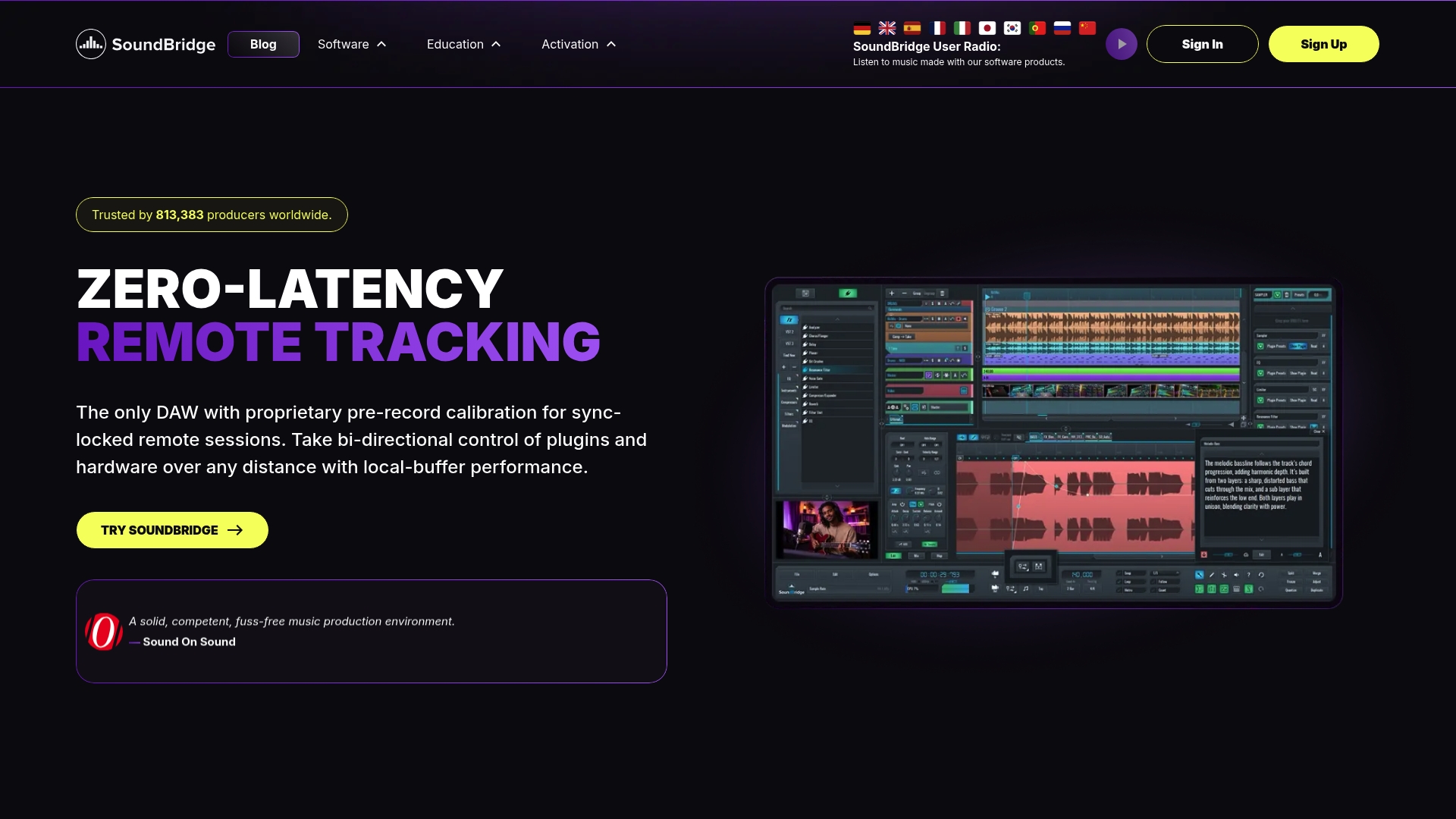
Self-hosted stacks give you control, but they also give you a to-do list: SSL renewals, Docker updates, PostgreSQL backups, and uptime monitoring. SoundBridge is the alternative when your priority is making music, not managing infrastructure, as explained in detail on VEU. You get zero-latency remote tracking, integrated video and talkback, bi-directional plugin and hardware control, and 192kHz audio fidelity, all without touching a terminal.
Migration from a self-hosted stack is straightforward: export your audio masters and project files, confirm sample-rate compatibility (SoundBridge supports up to 192kHz), and verify your file formats before switching. User roles transfer conceptually; you’ll recreate them inside SoundBridge’s session model.
Pro Tip: Run a hybrid workflow: keep a lightweight self-hosted archive server (Navidrome or NextSound) for completed project storage, and use SoundBridge for all active real-time sessions. You get data ownership on the archive side and zero-latency performance where it counts.
If you’re weighing cloud-based production against self-hosting, SoundBridge’s free tier lets you test the real-time workflow before committing. Start a session at soundbridge.io and hear the difference.
Key Takeaways
For most music teams, a Docker-based project stack with PostgreSQL and S3 storage delivers the best balance of collaboration features and data control, with SoundBridge as the zero-admin alternative for real-time sessions.
| Point | Details |
|---|---|
| Pick your path by workflow | Project teams need Docker stacks; library access needs Navidrome; social discovery needs Funkwhale. |
| Real-time jamming has physics limits. | Collaborators located far apart geographically will experience noticeable lag. |
| WebSocket rooms cut latency. | WebSocket streaming achieves 1–2s latency compared to 3–10s with standard HLS, making it practical for synchronized listening rooms and remote feedback sessions. |
| Persistent volumes are non-negotiable. | Mount audio storage to named Docker volumes or risk losing files on container restart. |
| SoundBridge removes the admin burden. | Zero-latency remote tracking and studio-grade features with no server management required. |
Recommended
MASTER MUSIC PRODUCTION
Expert-led courses designed to take you from fundamentals to finished tracks.

HOUSEFrom bouncy bass and solid kicks, this course teaches you the most modern House music production techniques needed to succeed and stand out.
TRAPQuit sounding like generic Trap and produce something World with hints of the Far East. Create ethnic soundscapes to put your Trap ahead of the curve.
AMBIENTProduce relaxing, sophisticated psy-influenced ambient. Psychedelic and relaxing to listen to, create meditative soundscapes to put your listeners in Zen.