

Songwriting Workflow: Build Your Process and Finish Songs
Last Edited: Jul 7, 2026

A songwriting workflow is a repeatable, structured process that moves you from raw idea to finished song by separating creative generation from editorial judgment. Without this separation, most writers stall, second-guess every line, and end up with folders full of half-finished demos. The most productive songwriters treat their process like a craft, not a mood. They follow 7–9 structured steps that allow a full draft to be completed in under one hour. That discipline is what separates writers who finish songs from writers who start them.
What are the core phases of a songwriting workflow?
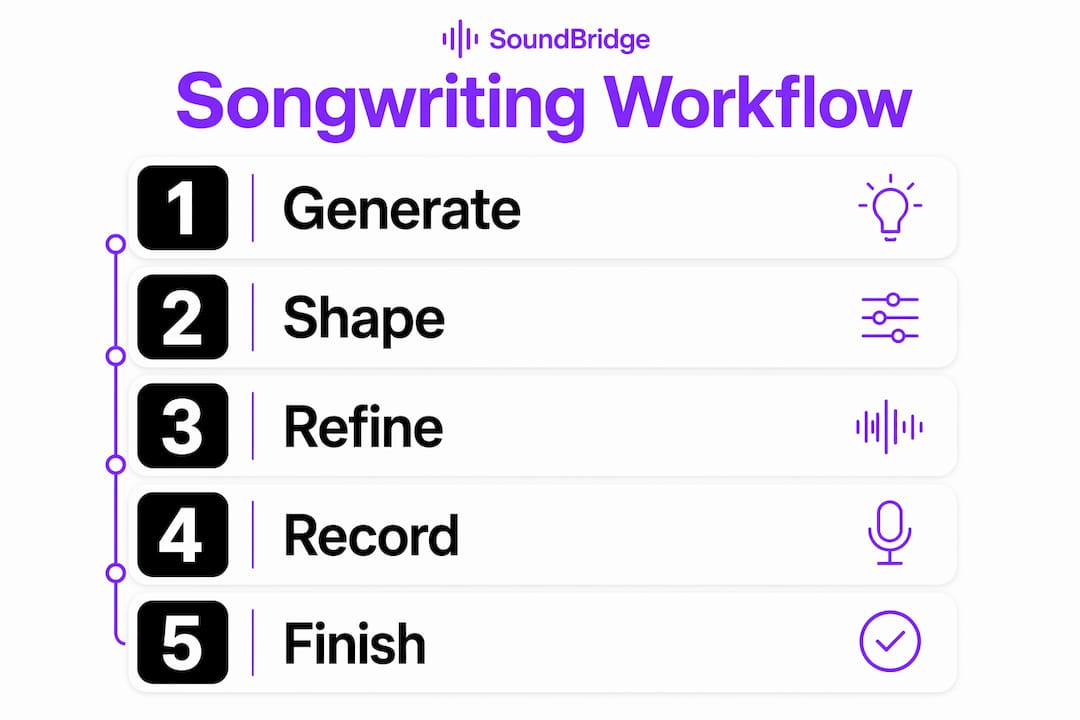
The most effective songwriting workflow divides into three distinct phases: Generate, Shape, and Refine. Separating these phases is the primary reason productive songwriters consistently finish projects instead of drowning in endless incomplete demos.
Each phase has a specific job, and mixing them is where most writers go wrong.
-
Generate. This is raw idea production with zero self-editing. You write every lyric fragment, melodic idea, or chord sequence that comes to mind. Nothing gets deleted. Nothing gets judged. The goal is volume, not quality. Think of it as filling a bucket before you decide what to keep.
-
Shape. Once you have raw material, you arrange it into a structure. You decide which lines belong in the verse, which belong in the chorus, and whether a bridge is needed. This is architectural work. You are not writing new content here. You are building a frame around what already exists.
-
Refine. The final phase is focused polishing. You tighten lyrics, smooth out rhyme schemes, adjust melodic pacing, and cut anything that does not serve the song’s emotional core. This is where craft takes over from instinct.
Keeping these phases separate protects your creative flow. When you try to generate and refine at the same time, your inner critic shuts down the creative engine before it can produce anything worth keeping. Professional songwriters call this trap “demo hell,” where a song never gets finished because every new idea triggers a round of second-guessing.
Pro Tip: Timebox each phase. Set a timer for 20 minutes of pure generation, then 20 minutes of shaping, then 20 minutes of refining. The clock creates urgency and prevents any one phase from consuming the entire session.

What Seed Ideas Do Professional Songwriters Start With?
Professional songs almost always begin with a single anchor rather than a complete concept. Research confirms that most songs start with one of three seed types: a title, a chord progression, or a melodic hook. Trying to develop all three simultaneously creates creative paralysis.
Each seed type has a distinct advantage:
-
Title first. Starting with a strong title gives you an emotional and lyrical destination before you write a single note. The title sets the tone, the theme, and the promise of the song. Every verse you write afterward has a clear target to aim at.
-
Chord progression first. The I–V–vi–IV progression appears in over 150 charting songs and remains the most reliable harmonic foundation in popular music. Starting with a chord progression gives you an emotional mood and a rhythmic feel before you touch a lyric. That harmonic grounding frees your brain to focus entirely on melody and words.
-
Melodic hook first. A strong melodic hook is a motor. Once you have a melody that sticks, lyrics tend to follow its natural rhythmic shape. Humming a hook over a simple beat often reveals syllable counts and emotional contours that guide the entire song.
The seed you choose shapes everything that follows. A title-first approach tends to produce lyrically focused songs with strong narrative arcs. A chord-first approach often yields groove-driven tracks where feel matters as much as words. A hook-first approach builds outward from the catchiest moment, which is a technique widely used in pop and R&B. Knowing your preferred entry point is one of the most practical creative songwriting tips you can apply immediately.
How Do Modern Tools Enhance Your Music Creation Workflow?
A digital audio workstation (DAW) is the central platform for every phase of the modern songwriting process. It lets you capture ideas instantly, arrange sections visually, and hear a working demo within minutes of starting a session. Understanding essential DAW features is no longer optional for serious songwriters. It is a baseline skill.
Modern tools that sharpen your process include:
-
AI-generated instrumentals. Dropping a generated beat or loop into your DAW gives you an instant harmonic and rhythmic canvas. Toplining, which means writing melody and lyrics over a pre-existing instrumental, is the industry-standard workflow in pop and hip-hop. Listening to a loop for 5–10 minutes before singing helps you find the rhythmic pockets where your melody will sit naturally.
-
MIDI tools and sample packs. MIDI instruments let you sketch chord progressions and melodies without needing to play every part live. Sample packs provide drum grooves, bass lines, and textural elements that spark ideas when you are stuck.
-
Remote collaboration platforms. Cloud-based production tools allow co-writers in different cities to work on the same session in real time. Soundbridge supports zero-latency remote collaboration with studio-accurate synchronization, which means your co-writer hears exactly what you hear, with no lag and no guesswork.
-
Version management. Cloud-based DAWs automatically save every iteration of your session. You can revert to an earlier arrangement without losing any work, which removes the fear of experimenting.
Pro Tip: Set up a dedicated writing space and schedule fixed sessions, even 30-minute blocks. A consistent physical and temporal environment trains your brain to enter creative mode faster every time you sit down.
What Techniques Help You Beat Writer’s Block and Write More Songs?
Writer’s block is not a creative failure. It is a signal that you are trying to generate and judge simultaneously. The fix is a technique, not a mood change. Consistent daily writing windows, even short ones, force creativity more reliably than waiting for inspiration.
-
Object writing. Pick any object and write about it for 5 minutes, using all 5 senses. This exercise, developed by Pat Pattison at Berklee College of Music, trains your brain to generate specific, sensory language fast. Specific language is what separates memorable lyrics from generic ones.
-
The 5-minute sprint. Set a timer and write without stopping. No backspacing, no rereading. The goal is to outrun your inner critic. Most writers produce at least one usable line per sprint, and that one line is often the seed for an entire verse.
-
Nonsense syllables and humming. Before you commit to real words, hum or mumble over your beat; this technique lets your melody develop naturally without the pressure of finding the right lyric immediately. Once the melodic shape feels right, the words tend to fall into place.
-
Constraints as creative fuel. Limit yourself to three chords, one genre, or a single rhyme scheme. Constraints force decisions and eliminate the paralysis of infinite options. Some of the most distinctive songs in history came from writers who imposed strict rules on themselves.
-
Rewriting the weakest line. Identify the one line in your draft that feels generic or forced. Rewrite it ten different ways. This targeted practice builds lyrical precision faster than rewriting the whole song.
Pro Tip: Build and maintain an idea bank. Keep a running list of titles, a voice memo folder of melodic fragments, a rhyme bank, and a chord library. Pre-made creative archives reduce the intimidation of starting a new song from zero.
How Does Song Structure Help You Finish What You Start?
Song structure is not a creative cage. It is a map that tells you exactly what to write next. Writers who understand structure finish more songs because they always know where they are in the process.
Common song forms and their emotional effects:
| Structure | Form | Best for |
|---|---|---|
| Verse-Chorus (VCVC) | Alternating verse and chorus | Pop, country, rock with a strong hook |
| VCVCBC | Verse, chorus, bridge added | Songs needing an emotional turn or release |
| VVCVC | Double verse before first chorus | Narrative-driven songs with story buildup |
| Linear / Through-composed | No repeating sections | Experimental, folk, or cinematic storytelling |
Writing the chorus first is the single most effective structural strategy for finishing songs. The chorus is the emotional destination. Every verse you write afterward has a clear purpose: to earn that chorus. Without a finished chorus, verses tend to wander without direction.
The most common stall point is around 80% completion. Songs that reach this stage often remain unfinished indefinitely because the writer keeps tweaking rather than deciding. The fix is a hard deadline. Give yourself a specific date and time when the song is done, regardless of how it feels. Deadlines force decisions that endless tweaking never will.
Practical finishing moves include writing the outro before the bridge, recording a rough vocal guide track to hear the full arc, and treating the bridge as a one-time emotional pivot rather than a second verse.
Key Takeaways
A structured, phased songwriting workflow that separates generation, shaping, and refining is the most reliable method for consistently finishing songs with creative clarity.
| Point | Details |
|---|---|
| Use three distinct phases | Generate raw ideas first, then shape structure, then refine. Never mix phases. |
| Start with one seed | Choose a title, chord progression, or melodic hook as your single entry point. |
| Write the chorus first | The chorus sets the emotional destination and keeps every verse on track. |
| Build an idea bank | Maintain title lists, melody memos, and chord libraries to reduce friction when starting. |
| Set hard deadlines | Most songs stall at 80% completion. A fixed finish date forces the decisions that matter. |
Why I Think the “Wait for Inspiration” Approach Is the Biggest Myth in Songwriting
The most damaging belief a songwriter can hold is that great songs require a special mood or a lightning-bolt moment. I have worked with writers at every level, and the ones who finish the most songs are not the most talented. They are the most disciplined.
Separating the Generate, Shape, and Refine phases changed how I think about creative work entirely. When I stopped trying to write a perfect line on the first pass, my output tripled. The Generate phase permitted me to write badly, and that permission is where the best ideas actually live.
The idea bank concept is underrated. Most writers treat every session as a blank slate. The productive ones treat every session as a withdrawal from a creative account they have been building for weeks. A title you jotted down on a Tuesday becomes the anchor for a song you finish on a Friday.
Digital tools matter more than most songwriters admit. A DAW that lets you capture a melodic idea in 30 seconds, layer a chord progression, and hear a rough demo in minutes removes the friction that kills momentum. Soundbridge’s cloud-based production environment makes that kind of fast, low-friction drafting available whether you are in a home studio or working remotely with a co-writer across the country.
Embrace imperfect drafts. A finished imperfect song is worth infinitely more than a perfect song that never gets completed.
— Wake
SoundBridge and Your Songwriting Process
Soundbridge is built for the way modern songwriters actually work: fast idea capture, flexible arrangement, and real-time collaboration without the technical friction.
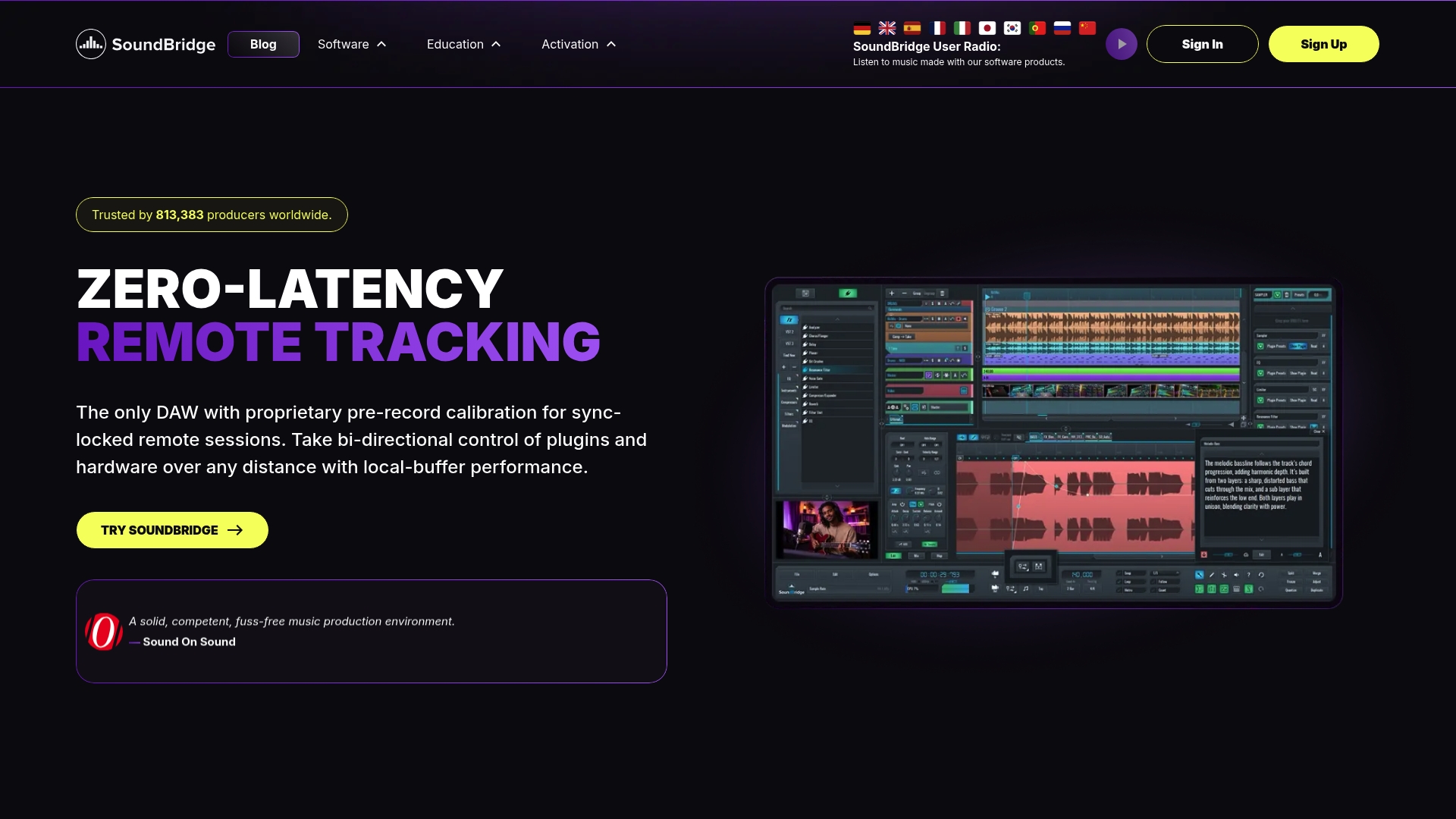
The platform supports every phase of your process. During the Generate phase, you can record vocal ideas, sketch MIDI progressions, and drop in loops instantly. During the Shape phase, Soundbridge’s visual arrangement tools let you drag sections, compare structures, and hear your song take form in real time. For remote co-writing sessions, Soundbridge delivers studio-accurate remote tracking with zero latency, so distance never slows the creative process. Whether you are new to DAWs or a seasoned producer, Soundbridge’s musician-focused DAW guide gives you the foundation to make the most of every session.
FAQ
What is a songwriting workflow?
A songwriting workflow is a repeatable, structured process that guides a writer from initial idea to finished song—the most effective workflows separate idea generation, structural arrangement, and lyrical refinement into distinct phases.
How long does it take to write a song using a structured process?
Structured workflows allow a full song draft to be completed in under one hour. Professional songwriting systems typically follow 7–9 steps designed to keep creative momentum moving without stalling on any single decision.
What is the best way to start writing a song?
Start with one seed: a title, a chord progression, or a melodic hook. Focusing on a single anchor reduces creative paralysis and gives every subsequent decision a clear reference point.
What is toplining in songwriting?
Toplining is the practice of writing melody and lyrics over a pre-existing instrumental. It is the standard workflow in pop and hip-hop, and it works best when you listen to the beat for several minutes before singing to identify natural rhythmic pockets.
Why do so many songs never get finished?
Most unfinished songs stall at around 80% completion because writers keep revising instead of deciding. Setting a hard deadline forces the final decisions that move a song from draft to done.
Recommended
MASTER MUSIC PRODUCTION
Expert-led courses designed to take you from fundamentals to finished tracks.
HOUSEFrom bouncy bass and solid kicks, this course teaches you the most modern House music production techniques needed to succeed and stand out.
TRAPQuit sounding like generic Trap and produce something World with hints of the Far East. Create ethnic soundscapes to put your Trap ahead of the curve.

AMBIENTProduce relaxing, sophisticated psy-influenced ambient. Psychedelic and relaxing to listen to, create meditative soundscapes to put your listeners in Zen.