

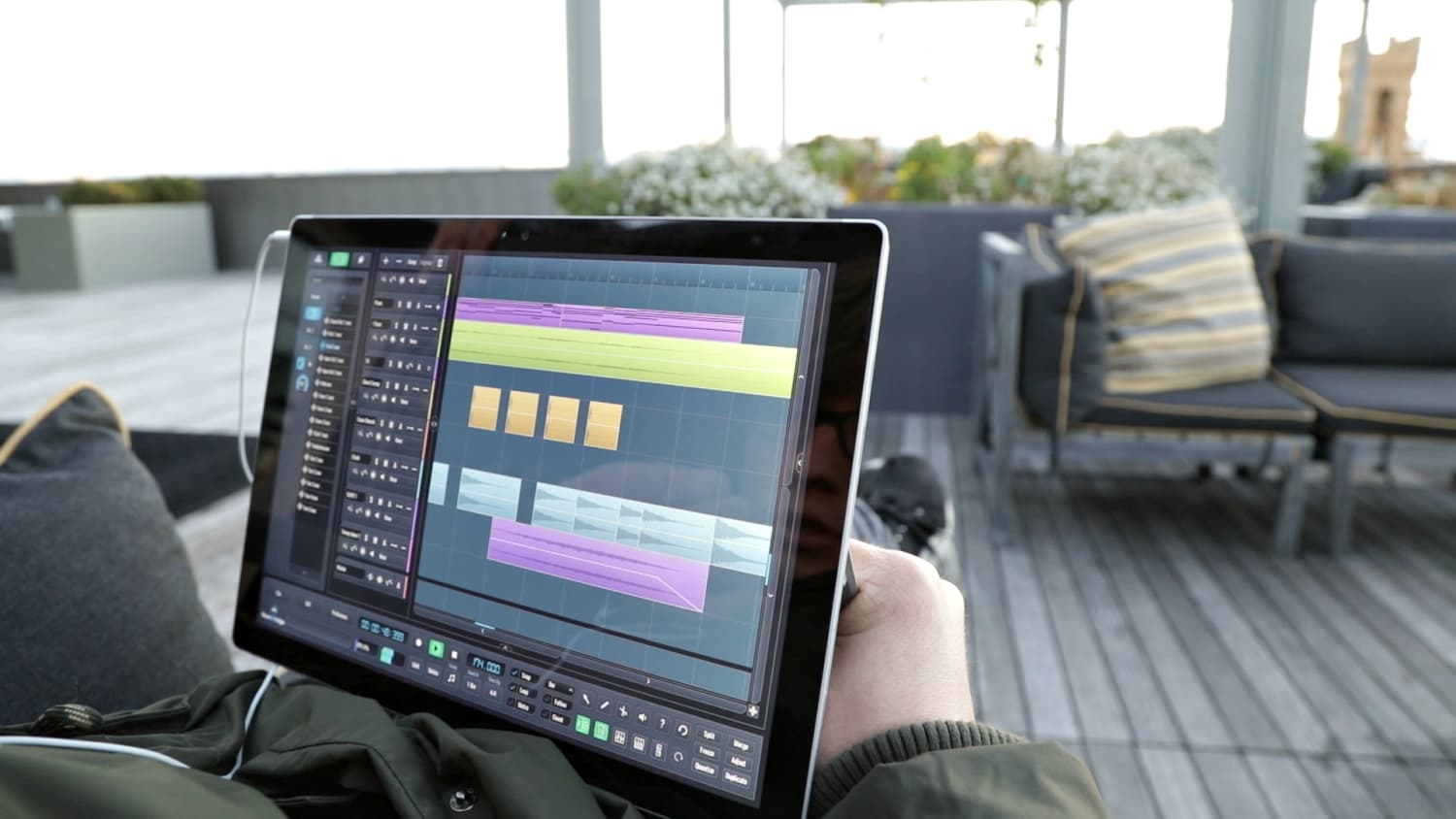
Quick Arrangement Tips: Song Structure
Last Edited: Nov 20, 2023
So you have a verse or a chorus and some introduction to it. Now, you need another section. There's not much time, so you can't start from scratch, but you don't want it to sound repetitive. Luckily, making variations and arranging musical phrases in SoundBridge is easy. With these compositional techniques and tools, you can generate possibilities for a new section or development on the fly. Here are eight tips on developing and arranging new material from existing ideas.
This is what my song structure looks like. The form goes: Intro, Verse, Chorus, Breakdown, Verse, Chorus, Hybrid Chorus, Outro. Using a proven song structure like this one is a good idea. You don't have to, but listeners are already used to these structures. A song structure like this provides enough variation and new information to keep listeners interested and enough repetition to make them feel anchored in the song.

Tips
1. Hint at a Previous Phrase
First and foremost, your first idea is precious. This is because it is the most genuine attempt you will make throughout the production at expressing what you want. Besides, it provides the starting point for all other ideas. So, instead of wasting time making something entirely new, consider using the same idea in a different context when thinking about generating a new section.
In my example, I took the phrase my bass was playing and turned a slightly modified version into a part for the next section. Try using techniques like transposition, inversion, retrograde, and augmentation for variation. Or remove, move, and add a note or two. This modification can be performed or created by editing a duplicate of your first idea. It's up to you.
~ Chorus cells hint at verse bass
2. Add New Elements
This one is pretty self-evident. Making a new song section without adding new elements is difficult. With that being said, it is easy to overdo it too. I would recommend adding only one new feature in focus. Any other additions should be some accompaniment. By "new element," I mean something that is both a unique timbre and role rather than a new timbre that has realized or substituted an existing idea. In my example, I added a piano in focus, two organ parts as accompaniment, and a horns section to accompany the bass.
~Piano, Organ, and Horns Intro
3. Substitute Roles
Often, you need the role that a particular instrument plays to be fulfilled, but you're sick of that timbre. This is where substitution comes in handy. Take my bass, for instance. I need those powerful subfrequencies in both the verse and the chorus, but I don't want the same timbre or notes as the first section. So, I created a sub-bass in FM8 to take over the role of occupying that frequency range. I also substituted the sub-kick drum for a different sample and a piano for a bell-like sound on specific repetitions of the melody.
~ Bells take over the piano roll
4. Hrmonic/Rhythmic Contrast
The most apparent and effective harmonic contrast is the modulation of another key. This is a technique that has been pushed aside by modern production. I would not recommend modulating to an unrelated key for this type of music, but perhaps a related key will work. The critical task is to make a new harmonic progression, a new chord formed by simultaneously sounding multiple tonal instruments. One easy way to satisfy harmonic contrast is to spare one section of harmonic content and save it for the next section so that it is more moving and exciting when it comes in.
In my example verse, I kept an ostinato as the main instrumental element, a phrase that hangs around one chord (the bass). I stuck with more spacey abstract sounds as accompaniment rather than layering harmonies over them so that when they enter the chorus, that depth is fresh and relieving. This is also essential to provide some contrast between the rhythmic aspects of the sections. For instance, if your overall groove is more staccato in the verse, try legato for the chorus. If your phrases are more melismatic in one section, try something more syllabic for the next section. In the audio example below, you'll hear my articulated ostinato turn into a set of chords in a simple harmonic rhythm.
~ Harmonic rhythm and chords entrance
5. Hybrid Sections/Phrases
If you have a few different ideas developed already, that's probably enough for the whole song. But that does not mean you can't make more material. Y you can still lengthen the piece by hybridizing sections and ideas. Maybe you'll take the accompaniment from the verse and listen to it over the melody from the chorus and the groove from the bridge. Perhaps you'll play the melody from one section on a different instrument over some drums from the verse. This technique works on a more micro level, too.
You can make a phrase hybrid of the melody and a background part or sound effect. I would suggest adding one new harmonic idea to the hybrid section somewhere low in the mix to keep things interesting. In my example song, I put my hybrid section at the end. They often sound nice after the last chorus of a song. I took the ostinato from the verse (a melodic theme in the chorus) and played it on a different instrument over the drums from the chorus and the accompaniment from the verse.
~ verse and chorus fused into a hybrid section
6. Density Contrast
A lot is good sometimes. A lot can only be fully appreciated after having experienced very little. This holds true when developing music. Giving you and other listeners a break from classifying many elements is essential. Typically, the chorus or drop has the most elements in it. The verses and bridge are more sparse, allowing the listener to recharge and understand where they are in the song. This does not mean you should skimp on the details of sparse sections. They are often more dynamic and detailed than the dense sections.
~ Breakdown section
7. U e a New Instrument as a Segue
This is a transition tip. A technique you might use to segue into and out of a section. A new team almost always follows the entrance of a new focused instrument led by that new instrument. For example, I used a piano to transition from the end of my first chorus into the bridge section.
~ Piano segues into the new section
8. Modify Instruments/Processing
This is perhaps the most effective way to add freshness to a new section in electronic production. S undBridge and other DAWs make creating duplicate tracks easy with further processing, edits, and automation. I used this technique on the drum loop for my chorus. I copied it to a new audio track. On that track, I dropped a high-pass filter at around 150 Hz to cut out the kick drum sub in the loop. Then, I replaced the role of the sub-kick with a Battery 4 sample. After that, I sent the filtered drum loop to a return track with a band-pass filter followed by a sixteenth-note delay and a stereo imager. Additionally, I blended this affected signal with the filtered original and the new sub-kick to form a uniquely processed loop. Change the key input to the unique drum loop if you had any side-chain signal from the original loop to instruments in this next section.
~ Drums move into a different processing space
MASTER MUSIC PRODUCTION
Expert-led courses designed to take you from fundamentals to finished tracks.
HOUSEFrom bouncy bass and solid kicks, this course teaches you the most modern House music production techniques needed to succeed and stand out.

TRAPQuit sounding like generic Trap and produce something World with hints of the Far East. Create ethnic soundscapes to put your Trap ahead of the curve.

AMBIENTProduce relaxing, sophisticated psy-influenced ambient. Psychedelic and relaxing to listen to, create meditative soundscapes to put your listeners in Zen.